
Women in Tree Nuts’ “What’s Shakin’ in the Industry” Event Just Laid Out Why 2026 Is a Critical Year for Central Valley Growers
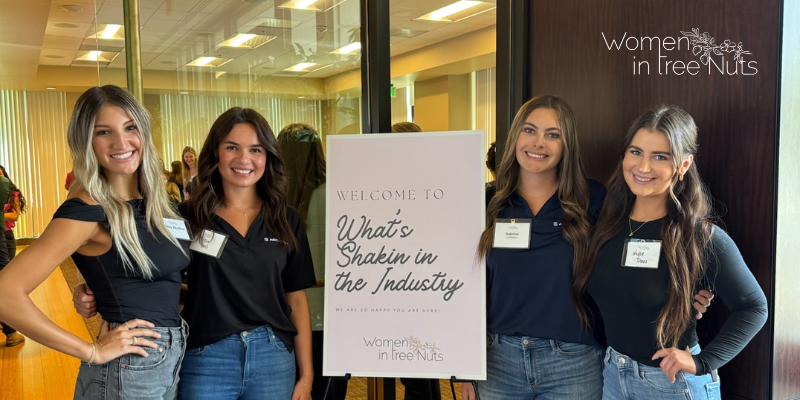
We had the opportunity to attend the Women in Tree Nuts “What’s Shakin’ in the Industry” event in Fresno last Wednesday, May 27th, and it was one of those afternoons that reminded us why these kinds of gatherings matter. The room was packed, the energy was great, and the presentations were filled with information that is directly relevant to anyone operating in the Central Valley tree nut space. Four expert speakers covered employment law compliance, food safety enforcement, SGMA implementation, and tree nut market forecasts and we left with a lot to share. Here are the highlights!
Labor Law: What’s Costing Employers Right Now
The first presentation came from Rissa Stuart, Esq., a partner at Kahn, Soares & Conway LLP, and she set the tone for the afternoon quickly. California’s minimum wage increased to $16.90 per hour effective January 1, 2026, but as Stuart made clear, that’s the least of most employers’ concerns. The real exposure right now is in meal, rest, and recovery break compliance, and the litigation activity in this space is significant.
What stood out to us was just how quickly premium pay obligations can add up. An employer who fails to provide a compliant meal period owes an additional hour of pay at the employee’s regular rate and the same rule applies to missed rest breaks. Stuart also covered overtime calculations, wage statement compliance under Labor Code §226, joint employer liability, and AB5 contractor classification; all framed in a way that was directly applicable to ag operations.
The portion of her presentation on ICE enforcement was one of the most relevant things we’ve heard discussed at an industry event in a while. Stuart walked through the legal difference between a judicial warrant, which must be signed by a judge to permit entry into private, non-public areas like fields and worker housing and an administrative warrant, which does not meet that bar. Her guidance was clear: designate a trained point of contact on every site before you need one, document everything if agents show up, and know that California Labor Code strictly prohibits retaliation against immigrant workers for asserting their labor rights. Preparation before an incident is everything.
She closed with the PAGA landscape, which is worth paying close attention to. Violations of wage and hour law can carry penalties of $100 per aggrieved employee per pay period, with 65% going to the state and 35% distributed to employees and personal liability is possible for those who cause violations to occur. Her overall message: implement compliant policies now, train your people, document everything, and don’t wait for a claim to find the gaps.
Food Safety: The Industry Is Raising the Bar
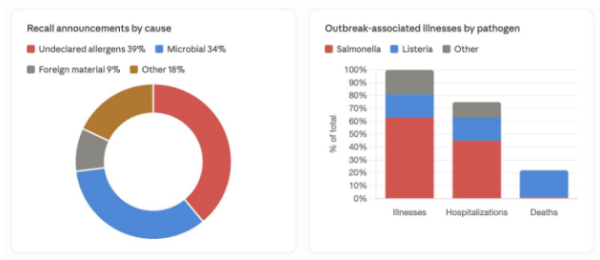
Hillari Bynum of DFA of California and the Safe Food Alliance was up next, and she opened with some numbers that put the stakes in perspective immediately. Undeclared allergens are the number one cause of food recalls, accounting for 39% of all recall announcements. Salmonella is behind 63% of outbreak-associated illnesses. And Listeria, particularly relevant for anyone in nut processing given the low-moisture environment, has been linked to 21 of the last 22 outbreak-related deaths. The financial picture is just as stark: the average market cap loss from a single recall event exceeds $400 million.
What we found most valuable about Bynum’s presentation was her emphasis on what buyers, auditors, and regulators are actually zeroing in on right now and it’s a clear shift from documentation to verification. Environmental monitoring programs, supply chain traceability, food safety culture, and proof that your systems are working on the floor, not just on paper. That distinction is becoming more important than ever.
On the regulatory side, FDA’s reorganized Human Foods Program is expected to be fully operational by mid-2026, with allergen management and low-moisture food sanitation both named enforcement priorities. Bynum also spent time on cybersecurity, not something we expected to hear at a food safety presentation, but it made sense. Malicious actors are increasingly targeting food and ag operations, and she was direct: the regulatory exposure is actually the least of your problems if a breach occurs.
Water: SGMA Is Here and the Clock Is Running
Madalyn Vieira, Esq., General Manager of Kings County Water District and founder of Valley Water Strategies, gave what we thought was one of the most grounded and actionable presentations of the afternoon. She didn’t sugarcoat where things stand. Across the Central Valley, basins are in very different places right now, Kings Subbasin has an active GSP with its monitoring network operational, Kaweah avoided probation and returned to local control, while Tulare Lake and Tule Subbasins are both in probationary status with extraction reporting and fee requirements already underway.
What we appreciated about Vieira’s approach was how she translated the regulatory picture into real operational terms. Metering, reporting, and allocation tracking are adding costs. Water reliability is now directly influencing land values and financing decisions. And groundwater-reliant properties in unmanaged white areas are facing increasing pressure as basins tighten heading toward the 2040 sustainability deadline.
Her strategic framework came down to four priorities: know your numbers, optimize irrigation efficiency, diversify water supplies where possible, and stay engaged with your GSA as rules continue to evolve. The near-term action list she gave the room was practical: read your basin’s adopted GSP, verify your wells are registered, confirm extraction metering is operational, and start building a farm-level water budget. The regulatory milestones between now and 2040 are on a fixed timeline, and the operations that plan ahead will be in a fundamentally stronger position than those that wait.
Market Outlook: Tightening Supply and Some Reasons for Optimism
David Magana, Ph.D., SVP Senior Analyst at Rabobank’s RaboResearch Food & Agribusiness division, closed out the afternoon with a market overview that covered a lot of ground. The macro backdrop is complicated: tariff uncertainty, a softening U.S. dollar, declining consumer confidence, and a K-shaped economy where higher-income consumers are holding spending while lower-income households pull back. But as Magana pointed out, tree nuts are sitting in the high-nutrient-density food category that is holding up well even in this environment, which is a meaningful tailwind for the industry.
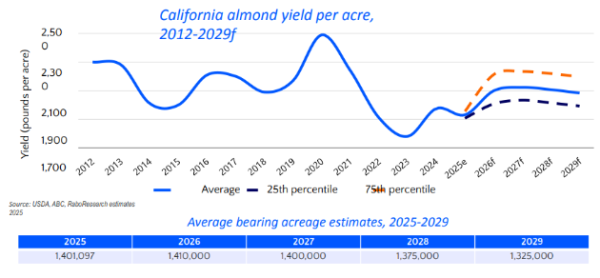
On almonds, the 2026 California crop is forecast at 2.70 billion pounds, down about 1% year over year, with bearing acreage at 1.39 million acres. Shipments through April were running 3% below the prior year, a 14% drop in domestic movement offset by exports that held at +1% YOY and made up 78% of total shipments. Inventories are tightening and near-term prices are biased higher. Rabobank’s forecast shows a gradual recovery continuing, though the $3.00+ average grower price isn’t projected to hold consistently until the 2029/30 marketing year.
Pistachios were the standout of the market discussion and honestly one of the more compelling stories we’ve heard this season. The 2026 California crop is shaping up to be materially smaller than expected, off-year dynamics combined with heat during the March bloom period hit pollination and nut set hard. Add in ongoing production and logistical challenges in Iran and Turkey, and the global supply picture is tightening fast. Shipments through March were up 22% YOY, inventories are declining, and Rabobank’s price outlook heading into 2026/27 is highly supportive, with downside risk considerably less severe than previously feared.
Walnuts also had a strong story to tell, shipments up 23% YOY through April driven by a 35% surge in exports, with prices stabilizing after bottoming earlier in the season. Pecans are trending higher as well, supported by tightening inshell supplies domestically and a renewed pickup in export demand. Across the board, the supply picture is moving in a direction that should be constructive for growers heading into the next couple of seasons.
Our Takeaway from the Day
Walking out of the event, what stayed with us most was how interconnected all of these issues are. Water constraints shape what you can grow and how you can finance it. Labor compliance affects your bottom line and your legal exposure. Food safety culture is increasingly a market access issue. And the macro forces Magana laid out, tariffs, exchange rates, consumer behavior, ripple all the way down to what a grower takes home at the end of the season. None of it exists in a box of its own, and events like this one are valuable precisely because they bring all of it into the same room.
About Women in Tree Nuts
Wednesday’s event was organized by Women in Tree Nuts, a professional network and 501(c)(3) built around one idea: no woman in this industry should have to figure it out alone. Hosting industry education events like this one is central to their mission, and the caliber of speakers in that room showed it. If you’re not already part of the WITN community, memberships for the 2026–2027 season are open now! Check it out at womenintreenuts.com.
WITN also has a full calendar of events ahead for the season: a Western Tree Nut Association gathering on June 10, Roots & Relationship in July, Tatas & Tinis in October, The Almond Conference Social in December, and an Out & About with WITN day trip. Member Zoom calls are held on the second Monday of every month at 2 p.m., and Kitchen Conferences are open to anyone interested in hosting.