
“We’re Going to Need Those Pounds”: California’s 2026 Pistachio Crop Comes In Light and Growers Are Bracing for It
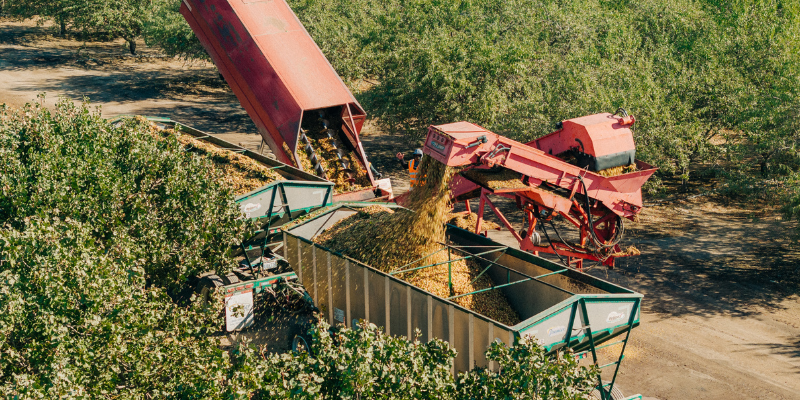
California’s pistachio growers are heading into harvest facing one of the lightest crops in years, the fallout from an unusually hot spring that scrambled pollination across broad stretches of the Central Valley. After a record-shattering 2025, some estimates now put the 2026 crop at roughly a third of last year’s haul, a swing big enough to reshape supplies, prices, and grower strategy heading into fall. At this year’s Pistachio Insights Day, growers told Ag Center News what the shortfall means on the ground.
A Bloom Cut Short by Heat
The trouble traces back to bloom. Pistachio pollen loses much of its viability once temperatures climb past roughly 85 degrees during flowering, and this year’s heat landed hardest in the southern San Joaquin Valley. The result is now visible in the orchards: an unusually high share of blank nuts, shells that never filled.
From a Record High to a Steep Drop
The contrast with last season is stark. The 2025 crop was a record-setter: USDA’s National Agricultural Statistics Service tracked bearing acreage and production climbing to new highs, with the industry topping 1.5 billion pounds and the U.S. holding its position as the world leader in pistachio output for a tenth straight year. For 2026, Kreps said estimates now range from around 900 million pounds down to as low as 600 million pounds, in his words, nearly a third of last year’s market. It is a textbook reminder of the crop’s natural “alternate bearing” swing, amplified this year by weather.
“The Price Can’t Catch Up That Much”
For growers, a light crop is only half the story, the other half is what it does to price. William Bourdeau, a Westlands-area grower, said the math rarely works out the way farmers hope. “It’s very tough when you farm all year and hope you’re going to get a crop to be able to at least pay the bills,” he said. “And when that crop comes in far less than you expected, you would hope that the price would kind of compensate for it.”
But it only goes so far. “When you’re estimating a 2 billion pound crop and it comes in more at 800 million, the price can’t catch up that much, because the price would be so high you create demand destruction going forward,” Bourdeau said. He pointed to the long game: “You want to maintain relationships. You don’t want to just sell pistachios one year and sell them at such a price that people have a hard time buying them.”
Bourdeau also noted that global supply is tightening as conflict disrupts production in Iran, the world’s other major pistachio producer, adding another layer of uncertainty to where prices land this season.
“Everybody Needs to Shake”
Even with a smaller crop, growers say the pounds still matter. Todd Azevedo of Stone Land Company urged growers to assess what they have and keep their processors in the loop. “Everybody needs to look at their crop and see what they’re going to get, and kind of let their processor know,” he said. “Even if there’s not much out there, everybody needs to shake, because we need those pounds. We’re gonna need that.”
Azevedo said the shortfall is already changing how he manages inputs, especially water. “As a grower, we’re cutting back on water, on some stuff and fertilizer and water especially, being in the Westlands too,” he said. “We’re saving water for our next year’s crop.” That trade-off, protecting next season while this one comes up short, is one many growers are weighing as they decide whether a harvest pass is even worth the cost.
“Plan on the Future, Not Just the Present”
Others are taking the long view. Mando Perez said this year echoes past down cycles the industry has weathered before. “You look back at 2015 when we had another year where it was very low, and you just had to rebound and see where that next season is going,” he said. “We just gotta plan on what the future is and not just what the present is, even though the yield might be low.”
Perez acknowledged some growers are leaning on crop insurance rather than shaking a thin crop at all, but he framed the season as a setback, not a crisis. “I would have the faith and the trust,” he said. “It’s going to make up for next year, and we’ll have a bigger crop.”
What It Means for Prices and Demand
A crop this small will inevitably tighten supplies, but growers and processors are wary of letting prices spike too aggressively, the demand-destruction risk Bourdeau described. Kreps expects the industry to work at moderating increases to protect the long-term demand California has spent years building at home and abroad, especially as the crop’s nutritional profile, promoted heavily by American Pistachio Growers, continues to pull in health-conscious consumers.
Harvest Timing and the Alternate-Bearing Swing
Harvest timing is shifting too. Many growing regions are expected to start picking about a week earlier than usual, though some growers may deliberately hold off to consolidate into a single pass, trimming costs, reducing stress on the trees, and preserving the buds that set up next year’s crop. Longer term, Kreps noted that newer varieties such as Golden Hills and Lost Hills, paired with better fertility and post-harvest nutrition programs, are helping growers smooth out the crop’s notorious swing between heavy and light years. Growers weighing production decisions can cross-check the numbers against official crop data through the California Department of Food and Agriculture.
The Bigger Picture
For all the difficulty of the current season, growers and industry leaders alike stay optimistic about what comes next. California still leads the world in pistachio quality and innovation, and expanding international demand, combined with continued investment in orchard management, keeps the industry well positioned for long-term growth. Or, as Perez put it: the yield may be light this year, but the faith is that next year makes up for it.