
Water, Regulations, and the Fight for California’s Farms: What Bianco and Hilton Told The Toast
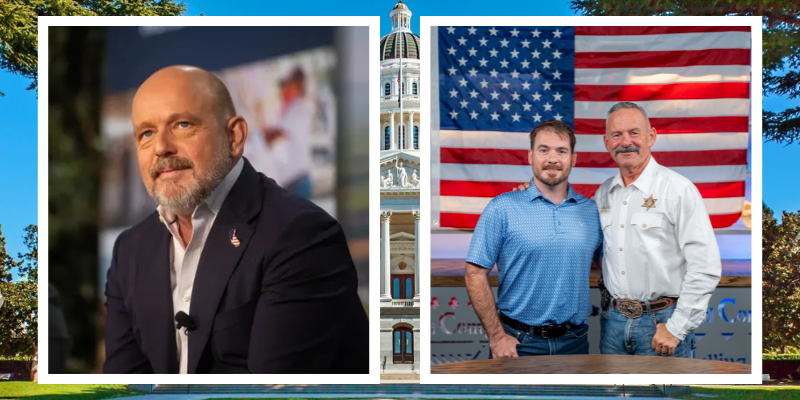
With the June primary closing in, two Republican candidates for governor sat down with Josh Rogina on The Toast podcast and spoke directly to the concerns of California’s farming community like water, regulations, labor, and the cost of doing business in a state that seems to be working against them.
Ask any farmer in the Central Valley what keeps them up at night and you will hear the same short list: water they cannot count on, regulations written by people who have never set foot on a farm, labor costs that make every harvest a gamble, and a state government that seems more interested in appeasing environmental activists than feeding the country. In back-to-back interviews on The Toast Podcast, Riverside County Sheriff Chad Bianco and political commentator Steve Hilton each made their case that they are the Republican candidate best positioned to change that and both went deep on the specific issues that are threatening California agriculture’s future.
Water: Scarcity By Design
No issue dominated either conversation more than water. California’s farmers have been squeezed for years from two directions simultaneously: surface water deliveries cut or made unpredictable by state agencies, and groundwater extraction capped under SGMA, the Sustainable Groundwater Management Act. The combination has forced growers to fallow fields, abandon tree crops they spent decades cultivating, and in many cases simply walk away.
Bianco described the situation in terms that will resonate with anyone who has watched water flow past their land and out to the ocean. “The geological fact of California is we have more water than any state in the country,” he said. “It’s all a management or mismanagement problem.” He argued that the water shortage is not natural but manufactured, the result of a deliberate policy to limit the agriculture industry’s independence. “If you want to control a population, you have to control their water and their food,” he told Josh Rogina. He pointed to Israel, a desert nation that meets its water needs almost entirely through ocean desalination, and asked why California, sitting on hundreds of miles of Pacific coastline, has refused to pursue the same solution. His answer was pointed: because controlling water means controlling farmers. “You will never convince me that an activist environmentalist knows better how to care for the land than a farmer.” stated Bianco.
Hilton approached the water crisis with the same conclusion but more policy detail. He has published a paper titled Water Abundance through his organization Golden Together, and recently visited the site of the long-delayed Sites Reservoir in Colusa County, a project first proposed 70 years ago and still trapped in environmental review. “We just sweep all that away. Got to get it built,” he said. He also described meeting strawberry farmers in Ventura County who for a century had diverted water from a local river to irrigate their fields, only to have that practice halted to protect a native trout species. The pattern, he argued, repeats itself across the state: environmental rules written by Sacramento bureaucrats who have no understanding of how farms actually work, and no accountability for the livelihoods they destroy. His prescription is structural, put agriculture industry leaders in charge of water management boards, build more storage, and replace scarcity thinking with an abundance mindset.
On SGMA specifically, both men signaled their intent to roll back groundwater pumping restrictions and the fees that come with them. Bianco called the fees a money grab and promised executive action on day one. Hilton noted that the root cause of unsustainable groundwater extraction is the absence of adequate surface water delivery, so by fixing the surface water problem the pressure on groundwater diminishes naturally.
Regulations: The Governor’s Pen As The Fastest Fix
One of the most important arguments both candidates made and one that farmers may find more encouraging than they expect is that the majority of what is crushing California agriculture does not require an act of the legislature to undo. It lives in regulations, not laws. And the governor can remove regulations with an executive order.
Bianco made this case directly and used Governor Newsom as inadvertent proof. After the Los Angeles fires in January, Newsom signed emergency orders suspending CEQA and the California Coastal Commission so that fire victims could rebuild without waiting years for environmental clearance. Bianco’s reaction was immediate: if those regulations could be suspended for political reasons in one part of the state, they can be suspended for economic reasons everywhere else. “He proved it can be done,” Bianco said. “If you have somebody willing to do it.” He promised to arrive on day one with a list of regulatory rollbacks already prepared such as business fees, construction permits, energy rules, and the bureaucratic frameworks that have made it nearly impossible to open, expand, or even maintain a farm operation in California.
Hilton brought a different kind of credibility to the same argument. Before moving to the United States, he worked inside 10 Downing Street as a senior adviser to Prime Minister David Cameron, where his focus was stripping back government regulation, work he described as a precursor to what has since been attempted at the federal level. He acknowledged that effort in the UK fell short, but said it taught him exactly how bureaucracies protect themselves and how a determined executive can defeat them. “You have to be forensic and detailed,” he said. His approach as governor would be to study each agency individually, from the Air Resources Board to the Pesticide Control Board, understand the specific rules governing appointments and authority, and replace the people running them with leaders who have a pro-agriculture, pro-business mindset. “As governor you run the executive branch,” he said. “You can fire people, you can replace them, you can reduce the size and scope of these agencies.”
Labor And The Immigration Question
For farmers managing seasonal harvests with tight margins, the labor situation has become another pressure point that feels increasingly impossible to navigate. Hilton addressed it with a combination of pragmatism and economic argument that cut against the usual political framing.
He acknowledged that agricultural labor in California has long depended on a workforce that includes undocumented workers, but he argued that the conversation too often skips a prior question: why does California have the highest unemployment rate in the country alongside a claimed labor shortage? His answer was the welfare system. He described visiting a dairy in the Central Valley where workers earning around $50,000 a year told him their partners were collecting more in welfare benefits and that couples were deliberately avoiding marriage to preserve those payments. “How is it possible that you can make more money on welfare than working in an agricultural job?” he said. Before importing labor, he argued, California should make it financially rational for the nearly three million working-age Californians who are not currently employed to take the jobs that are available.
He also noted that as governor, he would appoint the Labor Commissioner and oversee the Department of Industrial Relations, meaning he could change how labor laws are enforced and implemented, including the overtime rules that have driven up costs for farms with seasonal and variable hours. The current 40-hour overtime threshold, which replaced the previous 60-hour exemption for agricultural workers, was cited by both candidates as an example of a regulation made by people with no understanding of how harvest schedules actually work.
The Bigger Picture: Who Writes The Rules That Govern Your Farm
Beneath the specific policy debates, both interviews kept returning to the same underlying theme: the people making decisions about California agriculture have no connection to it. Bianco put it plainly. “The laws and regulations affecting agriculture were put in place by people that live in big cities in concrete jungles who have absolutely no idea where food even comes from,” he said. As governor, he pledged that no bill, regulation, or rule originating from Los Angeles or San Francisco that would harm the Central Valley’s ability to function would survive his desk.
Hilton made a similar promise and framed it in terms of representation, not just political representation, but putting people with actual agricultural expertise inside the agencies that currently work against farmers. The goal, he said, is to make sure that every water board, every land use agency, every regulatory body that touches California farming is run by people who understand what farming requires and want to see it succeed.
The June primary will determine which of these two men carries the Republican banner into the general election. What both interviews made clear is that the Central Valley is no longer a peripheral concern in this race, it is central to the argument that California is broken, and central to the vision of what fixing it would look like.
Watch The Full Interviews
Both full interviews are available on The Toast podcast. Watch and judge for yourself.
Chad Bianco — Full Interview on The Toast
Watch here: https://youtu.be/X_SGcv-tsB8?si=ESKTNvvzATb0uqkB
Steve Hilton — Full Interview on The Toast
Watch here: https://youtu.be/0ODa7M80e1k?si=fpEDi6J4dwkH5513
Campaign websites:
Chad Bianco for Governor: https://biancoforgovernor.com/
Steve Hilton for Governor: https://stevehiltonforgovernor.com/