
PG&E Pilot Pays Growers to Shift Pumping Hours, With Bill Protection Through 2027
Growers who move irrigation pumping away from high-price hours are earning bill credits under PG&E’s Hourly Flex Pricing pilot, and two more seasons of enrollment remain.
Fertilizer, fuel, equipment and labor have all climbed, and the latest farmworker wage increase adds to the squeeze. One cost growers may be able to pull back on is the power bill for their irrigation pumps.
PG&E’s Hourly Flex Pricing (HFP) pilot rewards growers for running pumps when electricity is cheaper. Prices change hour by hour, and growers who shift pumping away from the most expensive hours earn bill credits. Enrollment is free, and a bill protection feature means participants won’t pay more than they would on their regular PG&E rate.
How the Pilot Works
For most growers, taking part means moving pumping by an hour or two to take advantage of lower-cost hours.
Enrolled growers keep paying their normal PG&E bill. Each month, they also receive a statement comparing how they performed on the hourly rate against their current rate. If they beat the standard rate, they earn a bill credit for the difference. If they don’t, they simply pay their regular bill.
The pilot runs through 2027 so PG&E can study how growers respond to hourly pricing, which leaves two full growing seasons after this one. Changes to the program after 2027 haven’t been announced, and growers will be able to decide then which meters to keep on the rate.
Results depend on flexibility. Growers who can shift pumping by a few hours have the most to gain, while pumps that need to run around the clock have less room to save.
Growers across many crops take part, including nuts, citrus, stone fruit, tomatoes, table grapes, wine grapes and rice, along with reclamation and water districts. Pump automation helps but isn’t required.
Real Savings on the Farm
Enrolled growers recently received payouts for their first year in the program, with credits often covering at least one full monthly PG&E bill, depending on the weather, prices, and irrigation flexibility. Shifting pumping away from the highest-cost hours can also lower regular PG&E bills. One enrolled reclamation district reports that its power bills are the lowest they’ve been in 10 to 15 years, even as PG&E rates have risen.
A Central Valley pistachio grower who runs pumps without automation controls said the credits came at a good time. “Harvest came in at about 50% of a normal crop because of high temps during pollination. Plus with fertilizer, chemical and fuel costs way up, anything helps. To get back some credits with PG&E is a big win.”
Nuss Family Farms in Lodi, which grows bell peppers, tomatoes and other rotational row crops, enrolled its drip stations, which run low-horsepower pumps rather than deep wells. “We enrolled all of our pumps in the program and earned credits that amounted to 8% savings on our PG&E spending,” the farm said. “The credits knocked off our entire September PG&E bills, which really helps us late in the season.”
Tim Nuss, who farms with his family and works in business development for Yield Energy, the pilot’s implementer for agricultural customers, put the farm’s savings for the season at about $7,500. He said the program can fit a wide range of operations. “It could be a big 10,000-acre almond farm. It could be a 1,000-acre vegetable farm,” he said.
Planning Around Hourly Prices
Yield Energy is PG&E’s authorized implementer for agricultural customers in HFP. Before signing up, growers can have their historical usage reviewed to estimate potential savings. Once enrolled, they can see hourly prices for each pump forecast a week ahead, lock in those rates, and plan pumping around the cheapest hours.
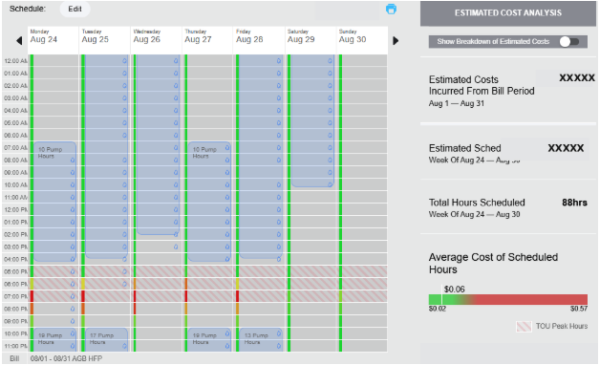
Caption: The Yield dashboard color-codes each hour from green (low price) to red (high price). The red-shaded band marks PG&E’s 5 to 8 p.m. peak hours to remind growers of demand charges. Growers can input a schedule plan to lock in prices (blue bars) and track actual pumping hours (water droplets). Growers are not penalized for running outside of scheduled hours.
Prices typically climb on hot days and in the evening, especially during PG&E’s 5 to 8 p.m. time-of-use window. Growers already working around those hours are well positioned to benefit.
“You can sit down on a Sunday, look at the week ahead, and see when those really high-price periods are,” Nuss said.
Growers with automation enter their pumping schedule in their controller, while others run pumps manually around the cheapest hours. Yield is also building integrations with irrigation automation companies, including WiseConn and Netafim, so hourly pricing shows up directly in those platforms.
“Growers can test hourly pricing without having to commit their pumps to a different rate plan,” said Brodie Roberts, Utility Program Manager at Yield Energy. “If a pump performs well, they earn a bill credit. If it doesn’t, we support growers to see if there are ways to improve pump performance, and if not, that pump stays on their current rate after the pilot ends.“
How to Enroll
HFP enrollment is open to new growers and to current participants who want to add more meters. All growers need is a recent PG&E bill.
Enroll today: https://energyinsight.pge.com/HFPXP?origin=AGR
Contact: Brodie Roberts, Utility Program Manager, Yield Energy, (559) 282-3835, brodie@yieldenergy.com, YieldEnergy.com