
Midterms 2026: What California Growers Should Keep in Mind Before Nov. 3
California votes on Tuesday, Nov. 3, and this ballot will shape water, labor and regulatory policy for farms and ranches for years to come. Voters are choosing a new governor, every member of the state’s U.S. House delegation, state legislators, and 14 statewide ballot measures. Several major water and farm policy decisions are also landing in the middle of the transition.
This guide does not endorse any candidate or measure. It lays out where things stand on the issues growers and ag professionals tell us matter most, and it links to the official documents and candidate materials behind each point so you can check them yourself.
Key dates for busy harvest weeks
If you’re still in the field, the most important date is this week: the Secretary of State recommends mailing your ballot at least seven days before Election Day so it’s postmarked in time. All dates below come from the Secretary of State’s official calendar and voter information guide.
| Date | What it means for you |
| Already passed: Oct. 19 | Regular registration deadline |
| Oct. 20 to Nov. 3 | Same-day (conditional) registration is open at your county elections office or vote center |
| Since Oct. 24 | Vote centers open for early in-person voting in Voter’s Choice Act counties (find a location) |
| Tuesday, Nov. 3 | Election Day; last day to vote in person or drop off a ballot, by 8 p.m. |
| Nov. 10 | Mailed ballots must be postmarked by Nov. 3 and arrive at your county by this date |
You can check your registration at voterstatus.sos.ca.gov and sign up to track your ballot at wheresmyballot.sos.ca.gov. The Secretary of State’s voter hotline is (800) 345-8683.
The governor’s race: where the candidates stand on farm issues
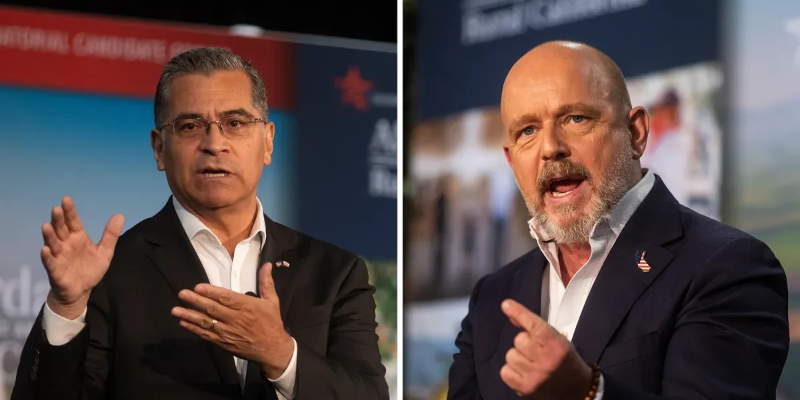
The open governor’s seat is the race with the most direct reach into farm policy, because the governor appoints the State Water Resources Control Board and sets direction for agencies like CDFA and the Air Resources Board. The two candidates on the ballot, per the Secretary of State’s certified list, are Democrat Xavier Becerra and Republican Steve Hilton. Neither bought a candidate statement in the official state voter guide, so the best record of their farm positions is what they’ve said directly to agricultural audiences.
Xavier Becerra (Democrat). In his statement for the California Farm Bureau’s 2026 voter guide, Becerra points to his Central Valley family roots and pledges water certainty, regulatory relief, and prosperity for both farmers and farmworkers. At the April agriculture-focused forum in Fresno, according to the host’s recap, he described affordability as a systemic problem needing coordinated fixes across sectors. He also called for trimming regulations that don’t relate to safety or production.
Steve Hilton (Republican). In his statement for the same Farm Bureau voter guide, Hilton pledges to protect water rights, expand water storage, rein in the Air Resources Board, cut costs, and eliminate regulations he considers unnecessary. At the Fresno forum, per the host’s recap, he proposed lowering vehicle fees, expanding in-state energy production, and shrinking the size of government. He described state policy toward agriculture as a failure that needs to change.
Where they overlap. At that forum, every candidate on stage raised a hand when asked whether California needs to rethink the balance between climate mandates and affordability. Candidates broadly supported more water storage and better conveyance. They split on specific projects and on the Sustainable Groundwater Management Act (SGMA), with some calling for major reform or repeal and others defending its intent while criticizing how it’s implemented. You can watch the full forum through the Western Growers link to hear each candidate in full.
Water decisions the next governor will inherit
Whoever wins, three of the biggest water decisions for California agriculture are already in motion and will carry into the new administration. Growers who depend on Sacramento River, Delta or State Water Project supplies should watch all three.
The Bay-Delta Plan, this week. The State Water Resources Control Board has scheduled a meeting on Oct. 28 and 29, continuing Oct. 30 if needed, to consider adopting updates to the Sacramento/Delta portion of the Bay-Delta Plan, according to its official meeting notice. The plan sets flow and water-quality requirements for the Sacramento River, its tributaries and the Delta, and it includes a framework for the proposed voluntary agreements with water users. The Board posted proposed final changes on Oct. 16. Implementation would fall largely to the next administration and its Water Board appointees.
Sites Reservoir. The proposed 1.5 million acre-foot off-stream reservoir west of Maxwell is listed by the California Water Commission at an estimated $6.2 to $6.8 billion. In June, the Governor’s Office announced it had become eligible for up to $1.363 billion in state Water Storage Investment Program funding. In September, the Governor’s Office said the project had moved into an investment period after the Sites Project Authority signaled that a revised State Water Board water right permit could support a viable project. Final financing commitments and construction will play out under the next governor.
The Delta Conveyance Project. The Department of Water Resources certified the environmental impact report for the proposed tunnel in December 2023, and it continues permitting and design work, according to the state’s CEQA record. Whether it moves to construction depends on further approvals and on the priorities of the next administration.
Congress, the farm bill and federal relief
Every California seat in the U.S. House is on the ballot, and the results will shape the farm bill’s final stretch. The House passed its version, the Farm, Food, and National Security Act of 2026, on April 30 by a vote of 224 to 200, according to the House Agriculture Committee. The Senate Agriculture Committee has since advanced its own bill, which it calls Farm Bill 2.0. It still needs a full Senate vote, and the two versions must be reconciled before anything reaches the president. Specialty crop research, conservation, crop insurance and nutrition programs all ride on how that plays out after the election.
Separately, USDA announced on Oct. 19 an $8 billion Harvest Fuel Relief program of one-time payments to help offset higher fuel and input costs for the 2026 crop year. Two points matter for California growers:
- Specialty crop growers aren’t covered by the initial payment formula. USDA is asking producers of non-Title I commodities to send data on their increased fuel costs to HarvestFuel@usda.gov for consideration when it sets payment rates.
- Applications will be pre-filled online for producers who have a Login.gov account linked to USDA, so setting that up now saves time later. Crop insurance enrollment isn’t required to participate.
The 14 statewide ballot measures
Fourteen propositions appear on every California ballot this year. The most reliable way to judge how one affects your operation is to read two official sources side by side: the Secretary of State’s voter guide, which includes each measure’s official summary, full text, and arguments for and against, and the nonpartisan Legislative Analyst’s Office, which estimates each measure’s fiscal impact.
One measure with a direct farm-labor connection is Proposition 1, an $11.25 billion housing bond. According to the Legislative Analyst’s Office, it includes $450 million in loans and grants to build or renovate farmworker housing. The LAO estimates the state’s cost to repay the bond at $500 million to $600 million a year for about 25 years. Measures dealing with taxes, the state budget and elections may also matter to your business, so check the full list in the guide.
Questions worth asking before you vote
Whatever your politics, these questions can help you compare candidates in any race on your ballot through the lens of your operation:
- Water supply. What specific steps would you take on surface water deliveries, storage, and the Bay-Delta Plan, and on what timeline?
- Groundwater. Would you keep, change, or replace SGMA, and how would that affect pumping in my subbasin?
- Regulatory costs. Which farm regulations would you change first, and how would you measure the savings?
- Labor. How would you approach farm labor availability, wages, and immigration enforcement’s effect on the workforce?
- Energy and fuel. What would you do about diesel, electricity, and compliance costs for farm equipment?
- Federal programs. For House candidates: where do you stand on the farm bill, specialty crop programs, and trade?
To see who is funding the campaigns and measures, use the Secretary of State’s Power Search and the Fair Political Practices Commission’s top contributors list. Official results will post after polls close at electionresults.sos.ca.gov.