
Farms Report Every Drop. Data Centers Report Nothing. Two Bills Aim to Change That.
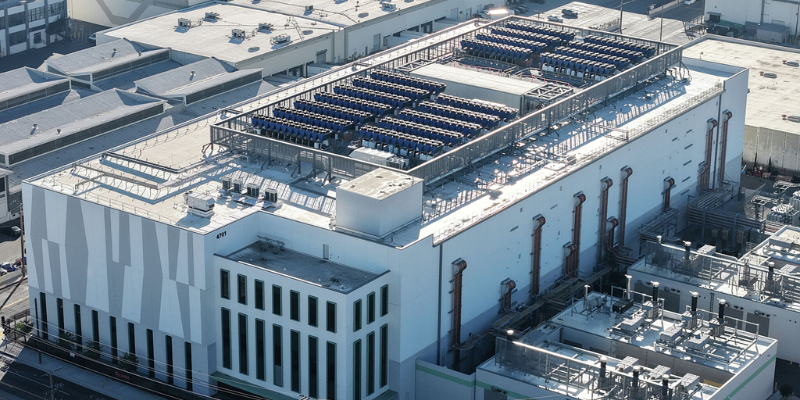
As artificial intelligence drives a building boom of data centers across California, a question that agriculture has been asking for years is finally landing in the state Legislature: how much water are these facilities actually using?
Right now, nobody is required to say. Two bills advancing in Sacramento would change that, and for growers already living under some of the strictest water-accounting rules in the country, the outcome is one to watch closely.
What the bills would do
Both measures come from Assemblymember Diane Papan, D–San Mateo, and both target the same blind spot from different ends of a data center’s life cycle.
AB 2469 would require developers to disclose projected water use before a local government can approve a new facility. Under the bill, a city or county could not approve a permit for a new or expanded data center unless the applicant submits a water scarcity plan, a water supply assessment, and a water use assessment. It would also require the applicant to assume responsibility for the cost of the water infrastructure needed to serve the project, rather than passing that burden to existing ratepayers.
AB 2619 picks up once a facility is running. It would require data center owners and operators to report their water use, including expected use, the source of that water, and projected volumes for the maximum day, maximum month, and average year, when they apply for or renew a local business license, all certified under penalty of perjury.
Put simply: AB 2469 is about what a facility says it will use before it’s built, and AB 2619 is about what it actually uses once it’s operating.
Both bills recently cleared the Assembly and are moving through the Legislature.
Why this matters for agriculture
Here is the part that should get every grower’s attention.
Under the Sustainable Groundwater Management Act, California farms already report their water use down to the acre-foot. In many basins, growers are being told to fallow land, meter their wells, and account for every drop they pump. Meanwhile, data centers are moving into some of those same water-stressed regions, competing for the same limited supply, with no comparable reporting requirement at all.
The scale of that demand is not trivial. Data centers rank among the most water-intensive commercial operations, and individual facilities can consume anywhere from hundreds of thousands to millions of gallons of water per day to cool their servers. California is now home to more than 330 data centers, according to Pew Research figures cited in recent reporting from The Sacramento Bee, and the number is climbing as AI investment surges.
For agriculture, the asymmetry is the whole story: one water user is measured to the acre-foot, and the other, often arriving in the same county, drawing from the same basin, has been essentially invisible on paper.
The veto hanging over it all
This is not the first time Papan has tried. Last year she authored AB 93, a similar disclosure measure, and Governor Gavin Newsom vetoed it on October 11, 2025.
In his veto message, Newsom wrote that he appreciated the author’s intent but was reluctant to impose rigid reporting requirements on operational details of the sector without first understanding the full impact on businesses and the consumers of their technology. He pointed to the “unprecedented” demand for data center capacity driven by AI as a reason for caution. Papan said at the time that she was “deeply disappointed” but committed to finding the right balance between innovation and sustainable resource management.
That history is exactly why this year’s fight is worth tracking. Supporters argue the industry’s rapid growth is not a reason to wait, it’s the reason to act now, before more facilities lock in water commitments that local agencies never fully evaluated.
The two sides
Backers frame the bills as basic transparency. “These bills don’t stop data center growth, but they make sure the public and our local water agencies finally get to see what’s happening and start to evaluate the real impacts before it’s too late,” said Kelly Shannon McNeill, managing director of LA Waterkeeper. Papan, for her part, has said she is “tremendously optimistic” and doesn’t think transparency “ever hurt anybody.”
Supporters also point to research suggesting the current system has real gaps. A February report from the UC Berkeley Center for Law, Energy & the Environment found that California’s oversight of data center water use relies on a patchwork of policies with significant holes, and a separate May report from Next 10 and Santa Clara University found those gaps let some projects avoid comprehensive review, even as data center development shifts toward water-stressed and rural communities.
Opponents counter that existing law already gives local agencies the information they need, and that data centers are being singled out unfairly. Kristopher Anderson, a policy advocate with the California Chamber of Commerce, argued that current law already provides water agencies the transparency they need to plan for a reliable supply. The Data Center Coalition, an industry trade group, warned that the legislation would make the state less competitive for future investment, arguing that any reporting or classification requirements should avoid imposing unnecessary burdens on the industry. Some local government groups have also raised concerns that the bills add state requirements to a process they believe should stay under local control.
One of the Berkeley study’s authors, Michael Kiparsky, pushed back on that last point: making a decision without full information, he argued, is “more like an illusion of autonomy.”
What to watch
The core question is whether these bills can survive where AB 93 did not. They’ve passed the Assembly, but the veto threat from last year hasn’t gone anywhere, and the industry opposition is well organized.
For growers, the stakes are straightforward. California agriculture has spent years being asked to account for its water with precision. These bills would begin asking the same of the fast-growing industry increasingly showing up next door and drawing from the same wells. Whether Sacramento follows through, or blinks again, is worth keeping an eye on.