
Dirty Solar Panels. Clogged Emitters. One Harvest Season Gone Wrong. Here’s What Valley Experts Are Warning Right Now
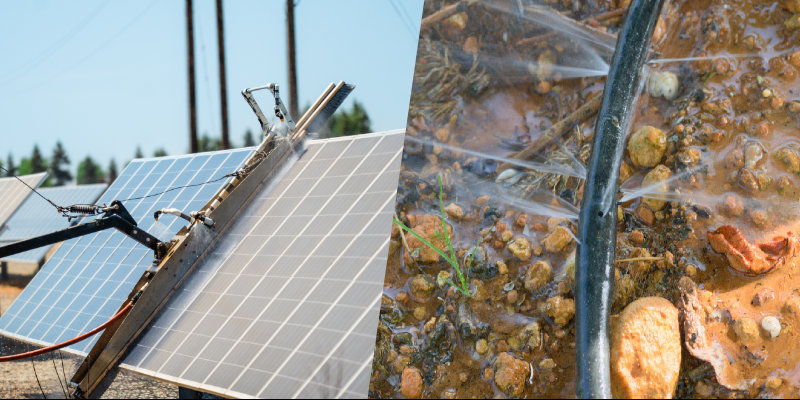
Heading into harvest, most growers are locked in on the crop, hull split timing, spray schedules, equipment logistics. But underneath all of it, two systems are quietly determining whether this season pays off: irrigation and solar. And according to the field experts keeping both running across the Central Valley, too many growers won’t find out there’s a problem until they’re already mid-harvest with no time to fix it.
This month, The Ag Center News sat down with Richie Medeiros from Central Irrigation and Kyle Espinola from Watts Up Solar Cleaning to get an honest look at what’s happening on farms right now.
The Emergency Calls No One Should Be Making
Central Irrigation’s phones are ringing constantly this time of year and not always for good reasons. Some of the most common calls involve emitter plugging, pump failures, and filter issues. None of these are unpredictable. All of them are avoidable. They can develop gradually and go unnoticed until the crop is visibly stressed during a heat wave, and by the time a grower calls during harvest, the window to respond without crop damage is already gone.
“It’s important to keep an eye on these things while temperatures and ET are moderate so that if repairs are necessary, you have the time to do it without affecting your crop.” — Richie, Central Irrigation
Before harvest equipment rolls, Richie’s checklist starts with leaks. Hoses, air vents, and underground piping need to be walked and inspected, a wet field at the wrong moment creates equipment access problems and crop quality risk that can’t be solved on the fly once shakers are scheduled. Pump performance needs to be verified, not assumed. Pumps lose efficiency gradually, which is exactly what makes it easy to miss. An under performing pump doesn’t just risk the crop, it costs more electricity to run. And for systems pushing 10 to 15 years, an honest repair-versus-replace conversation is overdue.
Water quality is the item that almost never makes the pre-harvest checklist. For drip and micro-irrigation systems, bacterial flare-ups can cause sudden, severe plugging with little warning, while scale buildup erodes performance slowly over time. Monitor flow and pressure, inspect emitters visually, and don’t wait for a visible failure to act, by the time it shows at the emitter, it’s been building in the system for a while.
“Check the field for leaks, it can cause major issues with harvest operations. For orchards, make sure your hose is secured so it doesn’t get caught in harvest equipment.” — Richie, Central Irrigation
What’s Baking Onto Your Solar Panels Right Now
The same heat compressing almond timelines and stressing irrigation systems is doing something else most growers aren’t thinking about, cooking a layer of grime onto their solar panels that a hose won’t touch.
When Kyle and his crew at Watts Up pull up to a system that hasn’t been professionally serviced, they find two distinct layers of buildup. The top layer of light daily dust can come off with rain or morning dew. The bottom layer, dense, baked-on residue adhered directly to the panel surface, doesn’t move without the right equipment and treated water. In summer, with the sun up by 5:00 a.m. and not setting until 8:00 p.m., any moisture that might soften that buildup evaporates before it has a chance to work.
“Think of it like caramel, you can soften caramel, but if you cook it too long, it turns hard and sticky. That’s what that dirt turns into on your panels.” — Kyle, Watts Up Solar Cleaning
The cost is real. AC systems across ag operations are running 30 to 40 percent harder in summer just to keep product from spoiling. Every point of solar output lost to soiling is power being pulled from the grid at peak rate. Watts Up recently cleaned a 3.5 megawatt system for a large grower-packer-shipper that had been maintained in-house for years, workers hosing panels periodically, never professionally scrubbed. Watts Up brought in a crew, deployed Symbiotics robots and Solatec brushes, and cleaned all 13,000 panels in three days. The result: a 35% increase in output, translating to $180,000–$250,000 in annual energy cost reduction from a single cleaning.
A lot of growers installed solar years ago and haven’t looked closely since. The assumption that a silent inverter means a healthy system is one of the most costly misconceptions in the field. When Watts Up cleans, they’re also checking whether trackers are tracking, inverters are collecting properly, and panels are broken or under performing. On a 10,000-panel system, 20 broken panels go unnoticed easily and those losses compound quietly over time.
“We’re in the field seeing every single panel. We mark the broken ones and connect growers with the right people to get their site running at full potential.” — Kyle, Watts Up Solar Cleaning
The Window Is Narrowing
Two systems. One season. And the time to act is right now.
The growers who get through harvest without a crisis are the ones who checked their fields, confirmed their pump performance, and didn’t wait to see what broke. The ones who find out mid-harvest that their irrigation was quietly failing or their solar system was running at 70 percent capacity, those are the calls no one wants to make.
The emergency doesn’t announce itself in advance. It just shows up when there’s no time left to deal with it.
Get in Touch
Watts Up Solar Cleaning For solar panel cleaning, efficiency assessments, and maintenance scheduling across the Central Valley. wattsupsolarcleaning.com
Central Irrigation For irrigation system inspections, repairs, pump service, and pre-harvest readiness across the Valley. centralirrigation.com