
California Diesel Just Broke $7.76 a Gallon and at Some Stations, Pumps Literally Ran Out of Digits Right as Some Growers are in peak Harvest
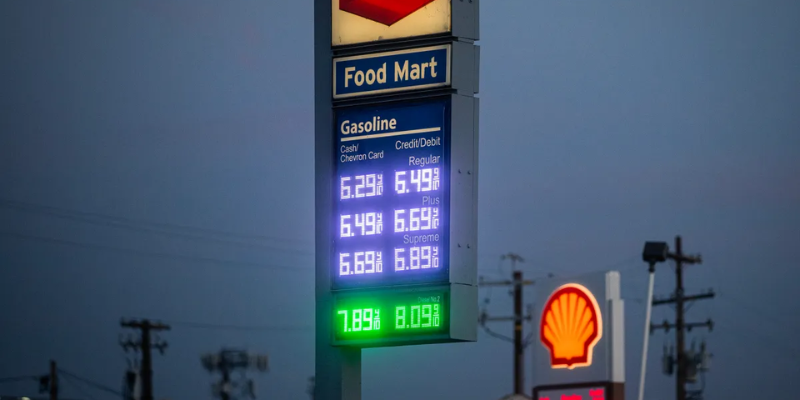
While the rest of the country panics over $6 diesel, California blew past it weeks ago. Now, with harvest ramping up, the Golden State’s growers are staring down the worst fuel squeeze in history at the worst possible moment.
If you’ve filled a tank in the Valley this week, you already know: something is very wrong.
The national average price of diesel just crossed $6.00 a gallon for the first time in history, but here in California, that would feel like a bargain. The state average has hit $7.76 a gallon, roughly $1.80 above the national number and up an eye-watering $2.81 from a year ago, according to U.S. Energy Information Administration data.
And that’s just the average. On September 10, GasBuddy’s head of petroleum analysis reported that five California stations had hit $9.999 a gallon, not because that’s the price, but because that’s the highest number the pump hardware can physically display. The dispensers, built in an era when nobody imagined a fourth digit, simply ran out of room.
Here’s the part that should make every grower in the Valley sit up: this is happening right now, in the exact weeks combines fire up for harvest.
Why California Always Gets Hit Hardest
When national diesel spikes, California doesn’t just follow, it detaches. There’s a structural reason growers here pay a permanent premium, and it’s getting worse.
California runs an isolated fuel market. As the San Francisco Chronicle explains, the state lacks pipelines connecting it to other U.S. refining regions, so when global crude spikes, West Coast refiners can’t just pull replacement barrels from Texas. On top of that, California requires its own unique low-sulfur CARB diesel blend, a cleaner fuel that only a handful of refineries can produce, with a customer list of essentially one state.
And that refining base is shrinking fast. Two major refineries have shut down in under a year, Phillips 66 in Los Angeles and Valero’s Benicia plant, erasing a big chunk of in-state capacity. Add the nation’s highest fuel taxes, over 87 cents a gallon on diesel alone, and you get a market that’s uniquely fragile when anything goes wrong globally.
Right now, plenty is going wrong.
The Global Storm Behind the Spike
Renewed conflict between the U.S. and Iran has raised fears about oil shipments through the Strait of Hormuz, pushing crude back above $100 a barrel. Meanwhile, Ukrainian strikes on Russian refineries have choked global diesel supply and as NPR reports, Russia is one of the largest diesel producers on the planet.
The result: U.S. diesel stockpiles have fallen to their lowest level in over two decades, dipping below 100 million barrels for the first time since 2003, even as refineries run nearly flat-out at 98% of capacity. You can track the supply picture yourself on the EIA’s Weekly Petroleum Status Report. There simply isn’t enough to go around and California is last in line.
The Cruel Irony: $6 Corn Meets $8 Diesel
Here’s what makes this so painful. After several brutal years, crop prices are finally rebounding, corn is pushing toward $5–6 and soybeans are sitting north of $12 a bushel. Growers should be celebrating.
Instead, that rally is being quietly swallowed whole. Jay Mahil, whose family has grown wine grapes, citrus and other crops in the Central Valley for four generations, told Yahoo Finance that the entire growing and harvest process runs on diesel that has become extraordinarily expensive.
Diesel powers everything on a working farm, combines, tractors, water pumps, and the trucks that haul product to the packinghouse, and harvest is the single most fuel-hungry stretch of the year. As The Washington Post put it, record diesel is hitting just when farmers need it most.
The math is unforgiving: when crop prices don’t rise fast enough to cover operating costs, higher diesel expenses hit margins almost immediately. And unlike a trucking company, a grower can’t just tack a fuel surcharge onto a bin of citrus. According to Pro Farmer, diesel is now up 61% nationally from a year earlier and in California, the gap is far wider. There’s nowhere to pass the cost.
The Logistics Domino Effect
Even growers who lock in their own fuel can’t escape the ripple. Diesel isn’t a household expense, it’s an input cost for the entire economy: trucking, rail freight, cold storage, and the long haul to port. When diesel spikes, every mile a crate of produce travels gets more expensive, and some businesses have already passed those costs down the line as added freight and delivery fees.
For a state that grows a huge share of the nation’s fruits, nuts, and vegetables, nearly all of it moved by diesel truck, a dollar-plus jump per gallon reshuffles the entire cost structure, from the field to the packinghouse to the grocery shelf.
What Valley Growers Can Do Right Now
There’s no magic switch, but operators aren’t powerless:
- Fuel up in the Central Valley, not on the coast. Truck stops along the I-5 and Highway 99 corridor typically run well below coastal California pricing.
- Tighten field logistics. Minimize idling, consolidate trips, and keep equipment maintained, small efficiencies add up fast at $8 a gallon.
- Lean on precision ag. Optimized routes and reduced overlap directly cut fuel burn.
- Watch the forward market. Track the EIA’s weekly price data and talk to your supplier about locking in before harvest peaks.
- Explore renewable diesel (R99). California consumes more renewable diesel than any state, and in some markets it’s now priced at parity with regular diesel, worth a phone call.
The Bottom Line
Will it last? Maybe not. A ceasefire, restored refinery capacity, or a demand slowdown could bring prices down as fast as they rose. But California’s structural problems, isolation, the CARB blend, shrinking refining capacity, aren’t going anywhere, and forecasters have already revised their diesel outlooks sharply upward.
The pump doesn’t care that you finally got a fair price for your corn. This harvest, the fuel gauge may decide who turns a profit and who doesn’t.
Watching the pump so you don’t have to. Check back for updates as the situation develops.
Prices cited as of the week ending September 12, 2026. Diesel markets are moving quickly, verify current local prices before making purchasing decisions.