
Cal Poly Wants to Pave Our Class 1 Soil To Build a Hotel, Housing, and a Conference Center. Alumni Hold the Leverage to Stop It.
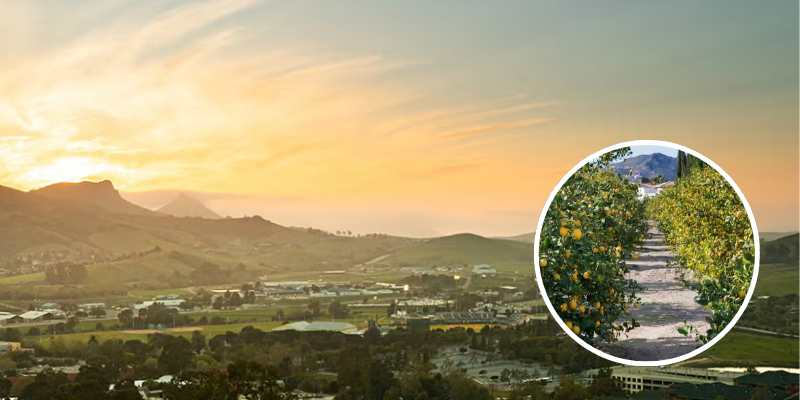
The West Campus proposal trades irreplaceable prime farmland for a hotel, senior living, and market-rate housing. If the administration won’t hear students, it will hear its donors.
For generations of Cal Poly ag students, the best classrooms on campus never had walls. They were the lemon groves and crop fields along the western edge of campus, where you could walk out of a lecture and, minutes later, be laying irrigation pipe, driving a tractor, or scouting pests in the same soil you’d study that afternoon.
What’s being proposed
President Jeffrey Armstrong’s administration now wants to build over a large piece of that ground. Cal Poly is exploring a mixed-use “West Campus District” near Highland Drive, a concept prepared for the university by real estate firm JLL, that could bring housing, a hotel and conference center, senior living, restaurants, retail, and other amenities to land currently farmed by students. Reporting puts the footprint at nearly 40 acres of campus agricultural land, and the university’s own May presentation estimated the development would cost more than $880 million, with projected returns of roughly $15 million to $40 million annually 15 to 25 years after completion.
Why the soil can’t be replaced
Here’s the part the administration would rather you glossed over: this isn’t spare ground. It’s Class 1 soil, the USDA’s highest tier of farmland, and, as retired plant sciences professor David Headrick has warned, topsoil that develops on a geological timeline of about 1 inch every 1,000 years. Once it’s under a parking lot, it’s gone. “Once you build on it,” Headrick wrote in August, “you never get it back.”
We’ve been here before
We’ve been here before, and that’s what should make every alum furious. In 2015, Armstrong’s administration considered a hotel near the lemon orchard at Highway 1 and Highland Drive, and pushback from students, alumni, and industry partners killed it. The university then wrote protection into policy: Master Plan 2035, finalized in 2020, explicitly excluded roughly 250 acres of prime farmland from development, the land now in play included. As recently as June 2025, after students gathered thousands of petition signatures, Cal Poly publicly took this ground off the table and declared the fields would remain agricultural. A little over a year later, the same proposal is back under a new name.
Students haven’t been quiet
ASI’s Board of Directors passed Resolution #25-07, “Opposing Non-Agricultural Development in All Areas of West Campus.” Ag communications junior and ASI representative Garret Gomes, one of its authors, put the reaction plainly: “It’s crazy in my mind.” A Change.org petition is demanding the administration withdraw the West Campus proposal and honor the 2020 commitment to exclude the prime farmland. Students have written to the CSU Chancellor’s Office. And the numbers are not small: reporting indicates the affected land serves roughly 1,173 students a year across 18 CAFES courses.
The “no net loss” dodge
The university’s answer is a semantic dodge. Spokesperson Keegan Koberl says no decisions have been made and promises there would be “no net loss” of agricultural land for student learning, that Cal Poly would provide more ag land than it does today. But “no net loss” of acreage is not the same as preserving Class 1 soil a ten-minute walk from lecture. The university has not said where replacement land would be, whether it would be prime farmland, or how anyone would haul students to fields on the far side of a highway without gutting lab time. Swapping irreplaceable soil for acreage somewhere less convenient isn’t preservation. It’s an accounting trick.
Why this fight needs alumni
There’s also a jurisdictional catch worth understanding. Because this is state-owned land, San Luis Obispo County has no land-use or permitting authority over the proposal. The normal public checks, county review, the usual CEQA path, don’t apply the way they would to a private developer. That removes one of the community’s ordinary tools. Which is exactly why the pressure has to come from the people the university actually depends on.
And that’s us. Cal Poly’s growth has been built on alumni generosity, the Frost gift, the Noyce School, building after building funded by supporters who believed “Learn by Doing” meant something. That belief is leverage, and it is the strongest leverage alumni hold. An administration that can wave off a student petition and its own Master Plan cannot as easily wave off a College of Agriculture whose donors have stopped writing checks to the general fund.
The ask
So this is the ask. If you’re an alum or industry partner who wants this stopped: pause your unrestricted giving, and tell University Development exactly why. Redirect what you can to CAFES departments and programs directly, where it funds teaching rather than concrete. Put it in writing to the Foundation and to the President’s Office that your support resumes when the West Campus proposal is formally withdrawn and the 2020 farmland protections are honored. Sign the petition, back Resolution #25-07, and get five other alumni to do the same.
The soil took ten thousand years to make. The decision window closes this fall. Alumni dollars are the one argument this administration has never been able to ignore.