
$40,000 Per Pipe: How the Golden Mussel Crisis Is Choking Delta Irrigation and Draining Farm Budgets
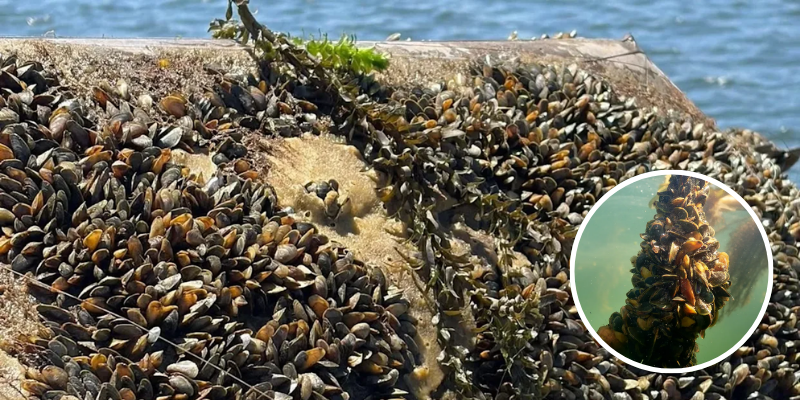
Two years after an invasive mollusk turned up at the Port of Stockton, Delta farmers are cutting off clogged irrigation siphons at $40,000 a pop, Kern County water districts are spending millions on chemical treatments and the state’s first real funding package amounts to $6 million, none of it earmarked for growers.
An invasive freshwater mussel no bigger than a thumbnail has become one of the most expensive problems in California agriculture and by nearly every account from the growers living with it, the worst is still ahead.
Golden mussels (Limnoperna fortunei), native to China and Southeast Asia, were first detected in North America in October 2024 at the Port of Stockton, most likely arriving in the ballast water of a cargo ship. In under two years they have spread more than 500 miles through California’s connected waterways, reaching south toward San Diego and, as of late June, as far north as the Port of West Sacramento, the northernmost detection confirmed to date, according to the California Department of Fish and Wildlife. CDFW’s genetics lab verified those West Sacramento specimens on June 25, 2026.
Critically for agriculture, the mussels have infiltrated both the State Water Project and the Central Valley Project, the twin systems that move Delta water to roughly 30 million Californians and millions of acres of farmland.
In the Delta: siphons, pumps, and a $35 million estimate
The most vulnerable agricultural infrastructure in the Delta is deceptively simple: hundreds of steel pipes that siphon river water into irrigation pumps and ditches, sustaining billions of dollars’ worth of tree nuts, winegrapes, tomatoes and row crops.
Christopher Neudeck, president of the Stockton engineering firm Kjeldsen, Sinnock & Neudeck, which serves many of the Delta’s reclamation districts, stated that mussels first showed up inside those siphons last year, and that the past six months brought an onslaught that has begun choking off water supply outright. Some growers, he said, are simply cutting the old steel pipe off and bolting on a new one.
That is not a cheap fix. Austin Loock, CEO of Delta Pump Co. in Stockton, said his company has replaced at least four mussel-clogged pumps for Delta farmers in recent months. A single siphon or pump replacement runs about $40,000, with no guarantee the new one fares any better.
Scaled across the Delta, Neudeck’s estimate to the San Joaquin County Office of Emergency Services puts the cost of replacing clogged siphons, pump stations and drainage pipes at more than $35 million.
For Trey Steinhart, operations director at Zuckerman Family Farms in San Joaquin County, the situation is already grim. None of the 30-plus siphons feeding his crops on McDonald Island have fully clogged, but every one of them has mussels inside, layered as much as two inches thick. “There’s nothing you can do to stop them,” he described.
His larger fear is the discharge pumps that drain excess irrigation water off Delta islands lying below sea level. If mussels foul those, thousands of acres go underwater.
And there’s a next-order threat growers are watching closely: microscopic larvae, called veligers, slipping past the sand media filters that protect drip lines and sprinkler systems, then maturing inside the drip system until emitters plug.
Andrew Genasci, executive director of the San Joaquin County Farm Bureau, framed the economics bluntly: it is a bill growers cannot afford to pay and cannot afford to skip, because without water access they are out of business. He warned that if no affordable protection emerges, the mussels could threaten the basic economic viability of Delta farms, at a moment when many operations are already sitting near break-even on high input costs and weak crop prices.
The stakes for the region are substantial. CalMatters reported that the Delta drives more than $4.6 billion in agricultural output, and quoted Neudeck warning that if the siphons plug up, “we’re going to lose billions of dollars worth of agricultural production.”
Down the aqueduct: Kern and Kings counties are already paying
The Delta isn’t the only farming region hit. Golden mussels have traveled hundreds of miles south through the California Aqueduct and into the water district pipelines that serve San Joaquin Valley farms.
In December, the Arvin-Edison Water Storage District, which supplies water to 130,000 acres of citrus, table grapes, potatoes and other crops in Kern County, discovered an extensive infestation in its tanks and pipelines. In March, the district spent $3 million on a 30-day copper-based chemical treatment that cleared its pipelines before growers were affected. Resource manager Samuel Blue noted the obvious catch: the district still takes in water from infested sources, so this is now a permanent, recurring cost.
The Westside Water Authority, serving districts in Kern and Kings counties, has spent $2 million on mussel eradication so far this year, with the figure expected to reach $3.8 million by year’s end. General manager Justin Rowe said rate increases for the farmers it serves are a certainty.
Here’s the asymmetry Delta growers face: those chemical treatments aren’t available to them. Because Delta irrigation water is pumped back into the estuary, environmental protections rule out the copper-based treatments used in closed district pipelines. Delta farmers are left with narrower, costlier workarounds, copper-based paints and adhesive ultrasonic “pucks” that vibrate mussels off surfaces, plus divers with scrapers.
Emergencies declared, and a $6 million response
The pressure has moved up the political chain fast. Three counties, San Joaquin, Sacramento and Kern, have declared local states of emergency over golden mussels this year, with San Joaquin County going first in April. The City of Stockton followed after mussels began fouling a key water pump station; a city official told the council that intake screens were 30% to 40% covered, and that with copper and UV treatment infeasible, crews were reduced to divers hand-scraping pipes.
Last week, Gov. Gavin Newsom signed a state budget that includes $6 million in one-time funding and $1.5 million in ongoing funding to fight golden mussels, as Stocktonia reported. The money is earmarked for boat and equipment decontamination stations in the Delta, prevention, in other words, aimed at keeping the mussels out of uninfested lakes and reservoirs.
Assemblymember Rhodesia Ransom (D-Tracy), whose district covers ground zero, welcomed the funding but warned that without urgent action, families will ultimately bear the cost through “higher water rates and increased food prices.” Ransom is also carrying AB 2032, which would speed up permitting so water agencies can respond faster to infestations.
The gap growers should note: it is not clear how much, if any, of that state money will directly reimburse farmers for siphon, pump or pipeline replacement. Genasci said reimbursement funding could be a lifesaver for Delta growers. As of now, it doesn’t exist.
The federal play
Washington is moving, but slowly. On May 20, Sens. Alex Padilla and Adam Schiff introduced the Golden Mussel Eradication and Control Act of 2026, which would create a demonstration program for prevention, monitoring, control and research, plus a competitive grant program open to state and local agencies, universities, nonprofits and industry partners. The senators pitched it in stark terms: the mussels threaten water quality for 27 million Californians and put more than $50 billion in agricultural production at risk. Rep. Josh Harder (D-Tracy) has a companion bill in the House. The measures seek roughly $15 million per year through 2030, and the federal grant program is explicitly aimed at removing mussels from water intakes and infrastructure, the piece most relevant to growers.
Separately, on June 2, a bipartisan group of Central Valley representatives, Jim Costa, Vince Fong, Josh Harder and David Valadao, sent a letter to U.S. Fish and Wildlife Service Director Brian Nesvik requesting emergency funding, a Lacey Act “injurious species” listing, and a national control and management plan.
A patchwork problem
Critics argue California’s response remains fragmented. In April, the Department of Water Resources quietly ended mandatory boat inspections at Lake Oroville, the state’s second-largest reservoir, citing a risk assessment that found cold, nutrient-poor water and fluctuating levels make permanent establishment unlikely there. Invasive species advocates counter that inconsistent protections across agencies create openings the mussels will exploit, a concern detailed in CalMatters’ reporting on the Oroville rollback. Assembly member Diane Papan’s AB 1772 would require CDFW to run a uniform statewide boat inspection and decontamination program.
Meanwhile, CDFW released a guidance document on July 3 to help public and private water agencies build invasive mussel control plans that satisfy state legal requirements, a template, not a solution.
The scientific consensus is sobering. UC Davis invasive species researcher Ted Grosholz has said that controlling mussels inside pipes and infrastructure is achievable, but eliminating them from the Delta itself is likely neither feasible nor cost-effective. Most experts expect golden mussels to remain in the Delta for years, if not permanently.
What growers can do now
- Inspect siphons, pumps and intake screens regularly. Mussels build in layers; two inches of buildup can accumulate without a full clog, and colonies re-establish quickly after cleaning.
- Watch your filtration. Veligers are microscopic. If you’re running drip or micro-sprinkler, talk to your PCA about whether your sand media filters are actually stopping larvae.
- Don’t forget drainage. For below-sea-level Delta islands, discharge pumps are a flood-risk exposure, not just an irrigation one.
- Follow Clean, Drain, Dry. Inspect anything that touched the water, drain bilges and ballasts, and let equipment dry fully before moving between water bodies.
- Report sightings to CDFW’s Invasive Species Program with a clear close-up photo and exact location: online reporting form, invasives@wildlife.ca.gov, or (866) 440-9530.
- Document your costs. With reimbursement programs still unwritten at both the state and federal level, growers with detailed records of mussel-related replacement and treatment spending will be best positioned if funding materializes.