
2026 Pistachio Estimate Holds Up as Harvest Closes and September Shipments Surge 40%
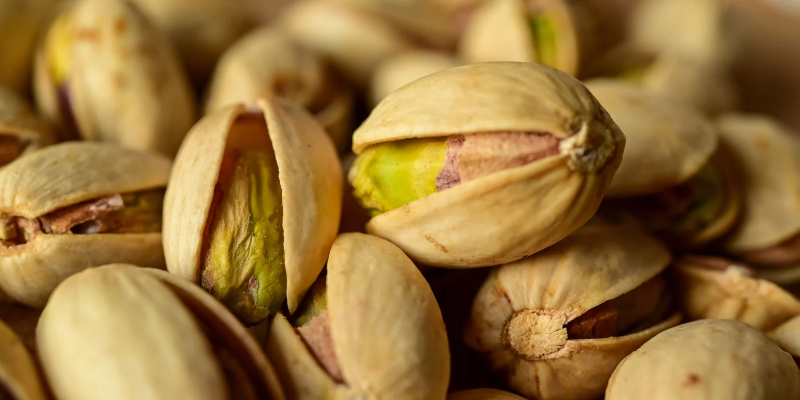
With harvest wrapped up, the August crop estimate is tracking close to the mark, the closed shell share is the highest since 2018, and export demand opened the new crop year at a record September pace.
In August, AGC News, Pacific Farm Management and West Hills Farm Services released our fourth annual Pistachio Crop Estimate. The call was a hard one to make: after a record 1.5765-billion-pound crop in 2025, we projected a 2026 crop of just 723 million pounds, based on a yield of 1,305 pounds per acre across 554,096 bearing acres.
That was a roughly 50% drop, driven by alternate bearing, a tight chill winter and the March heatwave that broke bloom synchronization and set the stage for heavy blanking. Two months later, harvest is closed and the first shipment report of the 2026/27 crop year is in. Here is how the estimate is holding up, and what September’s numbers say about the season ahead.
The estimate: tracking close to the mark
Through September 30, handlers reported 645.8 million pounds of 2026 crop receipts to the Administrative Committee for Pistachios (ACP). According to Mike Alamari, who led the estimate, another 50 to 60 million pounds came in during the first part of October before processors closed.
That puts the 2026 crop at roughly 700 million pounds, close to our 723-million-pound projection.
“It looks like we will be very close to the pistachio estimate this year,” Alamari said. “I think we will be within 2% again.”
That would mark a second straight year of near-miss accuracy. Our August 2025 estimate of 3,075 pounds per acre came in within about 1.5% of the final 3,030-pound yield. Final crop numbers will be confirmed once all handler receipts are reported.
Closed shell hits 20%, a level not seen since 2018
The biggest story in the receipts may be quality, not volume. Of the 645.8 million pounds received through September, 127.4 million pounds were closed shells, about 20% of the crop. Open inshell made up 477.1 million pounds (74%), and shelling stock 41.2 million pounds (6%).
“One important note is that this year’s closed shell percentage will be 20%. We have not seen that since 2018,” Alamari said. He added that the crop delivered in October was heavily closed, so the final share will move higher. “Inshell percentage will possibly be at its lowest ever on record going back to 1998 when processors began separating closed shell and shelling stock .”
The shift lines up with the nut-fill problems flagged in our August report. Poor pollination during the March heatwave left many kernels underdeveloped, and a nut that doesn’t fill well is less likely to split. For growers, a higher closed shell share means more of the crop is headed to shelling at lower value than premium open inshell.
Carryover came in a bit heavier than expected
In August we projected carryover into the 2026 crop year would settle around 150 million pounds. The ACP’s opening inventory as of August 31 came in at 167.5 million pounds, about 17 million pounds above that projection.
Adding carryover to September receipts gave the industry 813.2 million pounds of gross inventory. After the standard 12% inshell shrinkage and handler adjustments, adjusted inventory stood at 746.3 million pounds.
September shipments: exports open the year at a record pace
The industry shipped 88.4 million pounds in September, up 40% from 63.1 million pounds last September and the strongest opening month of the past four crop years. Alamari called the report “in line with expectations.”
| Crop year | Domestic (lbs) | Export (lbs) | Total (lbs) |
| 2026/27 | 19,312,554 | 69,107,121 | 88,419,675 |
| 2025/26 | 21,016,964 | 42,065,167 | 63,082,131 |
| 2024/25 | 21,569,539 | 32,943,397 | 54,512,936 |
| 2023/24 | 20,083,612 | 41,033,581 | 61,117,193 |
Exports did the heavy lifting, rising 64% to 69.1 million pounds. Asia more than doubled to 28.9 million pounds, led by Vietnam, which roughly tripled to 16.1 million pounds. India jumped from 260,000 pounds to 5.4 million pounds, and Hong Kong rose 25% to 5.3 million pounds.
Europe grew 45% to 25.8 million pounds, with Germany alone taking 9.9 million pounds. The Middle East and Africa rose 38% to 9.8 million pounds, helped by Turkey, which climbed from 0.9 million to 4.0 million pounds. Closed shell exports nearly tripled to 2.7 million pounds, most of it bound for Italy.
Domestic shipments were the soft spot, slipping 8% to 19.3 million pounds. Open inshell held steady, but domestic kernel shipments fell 18% to 7.4 million pounds, likely reflecting tighter kernel supplies early in the season.
The math ahead: a smaller pool and a hungry market
After September’s shipments, estimated marketable inventory stood at 657.9 million pounds on September 30. Adding the October deliveries, net of shrinkage, puts total supply for the year in the range of 790 to 800 million pounds.
That is roughly 30% less than the 1.14 billion pounds the industry shipped in the 2025/26 crop year. If September’s pace held all year, shipments would outrun supply well before next harvest. Something has to give, and the most likely release valve is price.
Our August report projected a record grower return of $3.35 per pound, up from $2.50 for the 2025 crop. September’s demand supports that outlook. A higher closed shell share could weigh on the average, though, since more of the crop will be sold as lower-value shelling stock and kernels. FOB pricing opened the last week of September for the 2026 crop at $6.50, nearly double the opening price for the 2025 crop. If prices hold at this level, growers should expect a grower return of $4.50. The 2025 bonus also was set at $1.40 for inshell and $2.00 for kernels with a possibility of ticking upward before finalizing it in January. That would place grower returns at $2.90 for $4.00 for kernels if they met all bonuses and incentives for the 2025 crop.
The caution from our August report still applies. The almond market in 2014/15 showed how pushing prices too high can drive industrial buyers to substitutes for years. With exports this strong, the industry’s challenge is to ration a short crop without losing the customers it has worked to build.
Sources: Administrative Committee for Pistachios Inventory/Shipment Report, September 2026 (released October 15, 2026); AGC News 2026 Pistachio Crop Estimate (August 2026).