
Almonds Are Dropping, Pistachios Are Moving, and the Valley Is at Full Capacity, So Here’s What’s Really Happening Behind the Scenes From The Experts
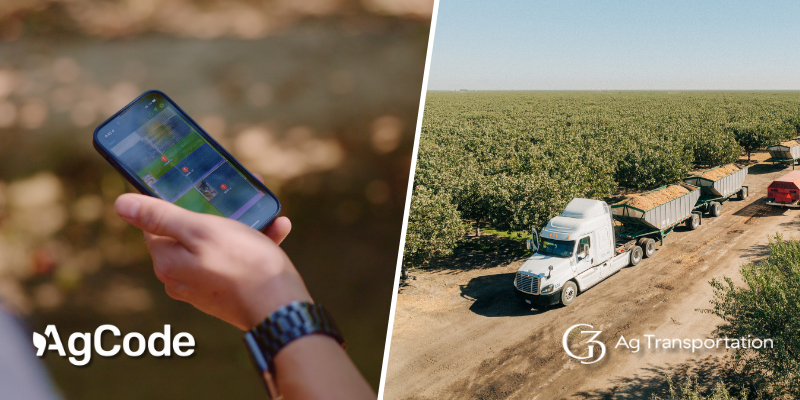
By the time a nut hits the ground, most of the hardest agronomic work is already done. But what happens next: how fast the crop moves, how well the operation is tracked, and whether the right information reaches the right people in time to act on it, determines just as much about how the season closes out. And according to the logistics and technology experts working alongside growers across the Central Valley right now, the operations that are going to come out ahead this harvest are the ones that planned before the chaos started.
This month, we sat down with experts from G3 Ag Transportation and AgCode to get a ground-level look at what’s happening on the movement and management side of harvest and what growers still have time to get right.
Organized Chaos, and Every Hour Matters
If you’ve never had to coordinate harvest transportation at peak season, Josh Little from G3 has a way of putting it in perspective.
“Peak harvest in the Valley is organized chaos, in the best possible way. Everybody needs trucks, trailers, and drivers at the same time, and the crop doesn’t care what your transportation plan looks like.” — Josh Little, G3 Enterprises
At peak, G3 is managing equipment availability, driver capacity, and trailer cycle times simultaneously across multiple commodities and customers. Almonds, pistachios, grapes, when those windows overlap, capacity gets tight fast. The pressure points aren’t dramatic. They’re logistical: a trailer that isn’t turning fast enough, a driver who isn’t where he needs to be, an empty that’s thirty minutes out when the harvester is ready now.
What makes harvest logistics unforgiving is the compounding effect of a single delay. One late truck doesn’t just mean one late load.
“If a trailer doesn’t get emptied, the next load can’t move, equipment starts backing up in the field, and pretty soon you’re affecting the harvester and the processor. The expensive part isn’t necessarily the truck, it’s everything waiting behind it.” — Josh Little, G3 Enterprises
G3 has been refining this kind of thinking since their early years hauling wine grapes, a commodity that taught them urgency in a way that translates directly to tree nuts. When fruit is ready, you move. The harvester doesn’t wait for a better Monday morning. That same discipline now drives how G3 approaches pistachio, walnut, and almond harvest: plan for the peak, not the average day.
“Don’t build your harvest transportation plan around your best-case day.” — Josh Little, G3 Enterprises
What a Coordinated Operation Actually Looks Like
There’s a telling sign that G3 is doing its job well and it’s the absence of noise.
“When we’re doing our job right, transportation should almost be boring. The harvester keeps moving, an empty is there when it’s needed, the full trailer leaves, and another one rotates in.” — Josh Little, G3 Enterprises
The contrast, when coordination breaks down, is immediate. Growers start making calls. Processors are asking where loads are. Drivers are getting redirected mid-route. G3’s goal is to absorb all of that before it reaches the grower.
“If the grower isn’t thinking about transportation, we’re probably doing it right.” — Josh Little, G3 Enterprises
For any operation that hasn’t yet locked in its transportation plan for this harvest, Josh’s advice is direct: call today. The closer harvest gets to peak, the fewer options everyone has. Early planning gives G3 time to position equipment, understand volume, and build contingencies. Late planning means competing for the same truck at the same time as everyone else.
Technology is the next frontier. G3 is actively looking at how AI can turn the data they already have – equipment location, availability, incoming demand – into faster, better decisions. Not to replace experienced dispatchers, but to give them better information in real time. For growers, that translates to fewer surprises and more reliable capacity when it matters most.
“In harvest logistics, bad news early is usually better than good news late.” — Josh Little, G3 Enterprises
The Data Problem Most Operations Don’t See Coming
While trucks and trailers are managing the physical movement of the crop, a separate but equally important challenge is playing out inside operations across the Valley and most growers won’t know it cost them until the season is already over.
According to AgCode, the most common gap heading into harvest isn’t a lack of data. It’s a lack of visibility into what that data is actually saying while there’s still time to act on it.
“The biggest gap we’re seeing is a lack of visibility into true harvest cost. Most operations don’t know if they’re on budget until weeks or even months after the season closes.” — AgCode
Labor hours tracked in one spreadsheet. Yield numbers coming through a separate system. Costs reconciled against neither until well after harvest closes. By the time someone notices a block is running over budget, the season is done, the information is only useful for next year, not for fixing anything now.
This isn’t a new problem. But with labor and input costs putting more pressure on margins than ever, the risk of not knowing your numbers in real time is higher than it’s ever been.
When the Information Arrives Too Late to Use
For operations still running on spreadsheets and manual tracking, the failure point during peak harvest usually isn’t accuracy, it’s timing.
“Spreadsheets can hold the right numbers, but they only get updated once a day, once a shift, or once someone has a free hour. During peak harvest, that’s rarely often enough. By the time the data is entered, the decision it would have informed has already been made.” — AgCode
Labor hours and equipment moves are typically the first things to slip. They change the fastest and get logged last. By the time an operation reconciles those numbers, the harvest window for that block has closed.
AgCode connects what’s typically siloed, field and block records, labor, equipment, work orders, harvest activity, yields, and costs, into a single picture that updates as the work happens. For citrus operations in particular, where multiple varieties and blocks come into harvest at overlapping times, that real-time visibility changes how the entire season is managed. Crews can be redirected based on what’s actually happening in the field, not what an end-of-day report says happened eight hours ago.
“The goal isn’t just a summary at the end of the day. It’s giving the people managing harvest the information they need to make decisions while the day is still unfolding.” — AgCode
What Gets Left on the Table
The operations that will feel the gap most this season are the ones managing multiple crops or varieties, several crews and pieces of equipment moving at once, and harvest windows that overlap rather than happen one at a time. That’s where manual tracking runs out of road fastest, regardless of crop.
AgCode’s consistent message is straightforward: start capturing information as the work is happening, not at the end of the shift or the end of the season. Historical data on costs, yields, labor, and field-level activity gives operations a real starting point for next year’s budget and harvest plan — built off actual operating history instead of estimates and memory.
“If you’re waiting weeks or months to know what harvest actually cost or how your operation performed, you’ve already missed the window to make changes.” — AgCode
The Season That Rewards Preparation
Both G3 and AgCode are pointing to the same underlying truth about this harvest season: preparation wins.
The companies with equipment positioned, drivers lined up, and clear communication between field, processor, and transportation provider will be in a far better position when the inevitable curveball comes. The operations that know their numbers in real time will have something to act on when a block runs over or a crew falls behind.
The problems that show up mid-harvest almost always started earlier, in a transportation plan that wasn’t built for the peak, or in data that wasn’t captured until it was too late to use. The season doesn’t slow down for either one.
Get in Touch
G3 Ag Transportation – For harvest transportation, logistics coordination, and capacity planning across the Central Valley. https://www.g3enterprises.com/logistics/transportation/ag
AgCode – For harvest management, data tracking, labor compliance, and real-time operational visibility. agcode.com