
Trump’s Tariff-Free Beef Push Escalates: 300,000 Tons Coming as Producers and Republicans Push Back
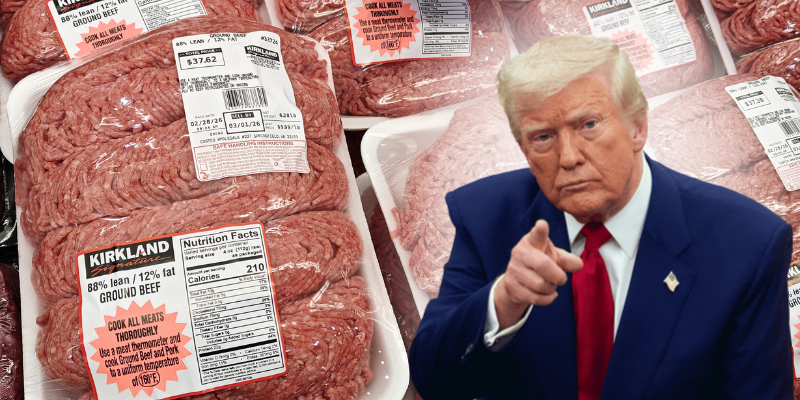
President Trump’s effort to knock down record beef prices by opening the door to more foreign product has hit its biggest escalation yet and the backlash from cattle producers, and even his own party, is growing.
In an August 21 Truth Social post, Trump said the United States will allow up to 300,000 metric tons of product for ground beef to be imported over the next 90 days with no out-of-quota tariff, alongside what he described as a commitment that the beef would be sold at 25 percent below current market prices. “This deal will reduce prices for Americans while giving space for our Great American Beef Herd to grow again,” Trump wrote. A White House official said foreign exporters would provide the 25 percent discount “to be passed along to American consumers” in exchange for tariff relief, but declined to name which countries or companies were involved. Pressed again on the tarmac at Joint Base Andrews, Trump said “I don’t want to say which countries but there are a few countries” that would supply the beef. As of this writing, the administration still has not publicly named the source countries, leaving open questions about origin, product standards, and how the discount would be enforced.
Critically, the move is still an announcement rather than a signed policy. The White House has said the executive order formalizing the tariff relief will be signed within two weeks of Friday’s post, meaning that as of this writing, growers watching for the binding fine print still don’t have it.
Building on the February Argentina deal
The announcement stacks on top of an already aggressive year of import expansion. In February, Trump signed a proclamation quadrupling the tariff-rate quota for Argentine lean beef trimmings, adding 80,000 metric tons for 2026 on top of Argentina’s existing 20,000-ton quota and releasing it in four quarterly tranches. That order was issued a day after the U.S. and Argentina signed a reciprocal trade and investment agreement, under which Argentina agreed to remove trade barriers on more than 200 categories of U.S. goods.
Why the administration says it’s acting
The backdrop is a domestic herd in decline. The U.S. beef cow herd sits at its lowest level in more than 50 years: the result, AFBF economists note, not of weak incentives but of drought and record production costs that made expansion a financial risk. There are early signs of recovery: cow-calf producers are beginning to hold back heifers and rebuild, though analysts note full herd recovery typically takes years, not months. Meanwhile ground beef has run at record highs, with Bureau of Labor Statistics data showing the average retail price reaching a record $6.90 per pound in April 2026 and holding near that level since. The administration frames imports as short-term relief for consumers while the herd rebuilds.
Why producers are pushing back
Cattle groups say the math doesn’t work, and the politics are transparent. Cattle markets turned sharply lower Friday morning following the announcement.
The National Cattlemen’s Beef Association (NCBA) said it was disappointed. In its official August 21 statement, CEO Colin Woodall warned that “flooding the market with government-subsidized, below-market beef is not the way to rebuild the American cattle herd,” noting cattle markets had already turned sharply lower that morning. He added that the intervention “sacrifices long-term stability for short-term messaging.” To put the volume in perspective, one market analyst noted the additional imports equate to about 44 days’ worth of U.S. ground beef consumption.
The U.S. Cattlemen’s Association (USCA) noted that 300,000 metric tons represents roughly half of total U.S. beef export volume so far in 2026, a large volume to absorb on a compressed timeline that lines up with the run-up to November’s midterms. USCA President Justin Tupper said ranchers “are being used as pawns in a 90-day political timeline,” warning that price-fixed foreign beef risks eroding the consumer trust the industry depends on.
What last fall tells us about calf prices
Producers don’t have to guess at the potential market impact, there’s a recent precedent. As Drovers noted in a market analysis, when Trump announced a similar import plan on October 16, 2025, expanding the Argentine quota and relaxing Brazilian tariffs, prices reacted sharply. Arkansas steer calves, averaging $421/cwt at the time, fell $41/cwt to $380 within two weeks, while feeder steers dropped $28/cwt over the same stretch.
The timing of the current announcement makes that precedent especially relevant: it lands just as many producers are beginning to market calves, meaning an unexpected surge in imports over a compressed 90-day window could put real downward pressure on the prices growers are counting on this fall.
The politics: a rural-vote problem
The backlash is notable for crossing party lines. As Roll Call reported, the announcement lands as Republicans face mounting pressure over cost-of-living ahead of the midterms, and as Trump has been losing ground among rural voters. Republican senators from cattle country broke with the president: Sen. Deb Fischer of Nebraska said, “we cannot do it at the expense of American producers,” while Sen. Mike Rounds of South Dakota tied any support to getting Mandatory Country of Origin Labeling in place. Democrats seized on it too, with the “$20 billion to Argentina” line, a reference to the broader U.S. financial support for Buenos Aires, becoming a rallying point against the plan.
Will it even lower prices?
Even sympathetic analysts are skeptical. The American Farm Bureau Federation calculates that 300,000 metric tons would be an unprecedented move, nearly a 60 percent jump in imports over 90 days, on top of a record pace. Per AFBF’s own Market Intel, U.S. beef imports ran 562,000 metric tons in the first quarter of 2026 alone, valued at nearly $4.5 billion, up 18 percent year-over-year and 122 percent above five years ago. But much of the largest supply isn’t affected by the waiver: Canada and Mexico already move product duty-free under USMCA and aren’t constrained by the quota, and Brazil has been receiving separate tariff accommodation. Analysts have also flagged that the “25 percent below market” figure may describe roughly where imported lean trimmings already price, rather than a genuine new concession.
On August 26, AFBF published a fresh analysis and President Zippy Duvall sent a letter directly to President Trump urging him to reconsider. The Farm Bureau’s central warning is about timing: it estimates 70 percent of spring-born calves are sold between September and November, squarely inside the 90-day import window, so a glut of foreign beef could drive down the prices ranchers receive at the exact moment they’re making critical herd decisions. Duvall’s letter argued plainly that bringing down the price of cattle will not bring down the price of beef for families, and would instead discourage the long-term investment needed to rebuild the herd.
The Congressional Research Service has noted that some analysts believe added imports would have a negligible effect on U.S. retail prices, while producers warn of a ripple effect through feed suppliers, equipment dealers, veterinarians, and other rural businesses. Congress is already engaging: H.R. 7567, passed by the House on April 30, would require USDA and the U.S. Trade Representative to jointly report on how changes to the Argentine beef quota would affect U.S. cattle markets.
The food-safety wrinkle
Producer groups have also raised animal-health and inspection concerns. Just two weeks before the announcement, on August 7, Corte Argentino USA recalled approximately 29,628 pounds of raw Argentine beef that had entered the country without the required import reinspection, with product distributed to distributors and retailers in Florida and Texas: a sign, critics say, that the inspection system is already strained. NCBA has also repeatedly cited Argentina’s long history of foot-and-mouth disease as a risk that could decimate domestic livestock production, and points to a lopsided trade relationship: over the past five years Argentina shipped more than $800 million of beef to the U.S. while buying only about $7 million of American beef.
The bottom line for growers
For producers who’ve finally seen profitable cattle prices after years of break-even, the concern is straightforward: a wave of below-market foreign beef arriving right as the herd is supposed to be rebuilding could undercut the very price signals that make expansion possible. The industry’s ask has been consistent, let the market work, and focus federal energy on rebuilding the domestic herd rather than importing around the shortage. With the executive order still unsigned and the source countries still unnamed nearly a week after the announcement, the coming days will tell growers how much of Friday’s announcement becomes binding policy and last fall’s calf-price drop shows the stakes aren’t hypothetical.
This story is closely tied to the reopening of the U.S.-Mexico cattle border over New World screwworm, see the companion article. Details may change as the executive order is finalized; check USDA and industry sources for the latest.