
Turning Good Lettuce Back Into the Soil: How a Cyclospora Recall Is Hitting California Growers Who Had No Part In It
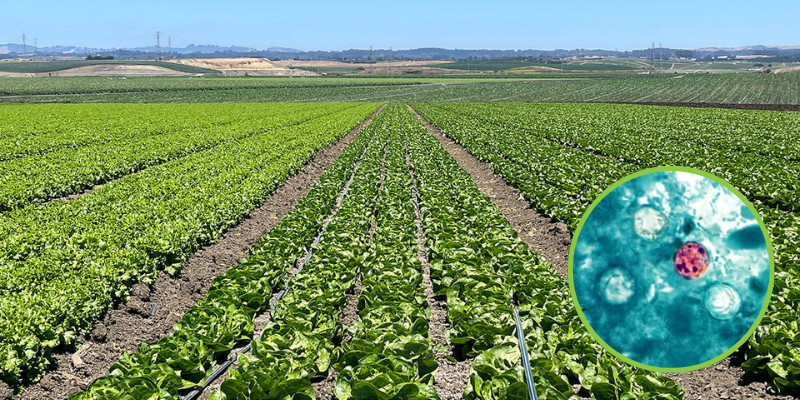
In the Salinas Valley, the stretch of central California coast that produces the majority of the nation’s leafy greens, some growers are watching mature, marketable lettuce get chopped and turned back into the dirt. Not because it’s contaminated. Because no one is buying it.
The reason lies more than a thousand miles away, in central Mexico, and in a parasite most consumers had never heard of two months ago.
The outbreak that started it
Since May 1, 2026, the Centers for Disease Control and Prevention has logged 6,707 laboratory-confirmed domestic cases of cyclosporiasis, an intestinal illness caused by the microscopic Cyclospora parasite. The agency says it is aware of more than 11,500 additional suspected cases .
still under investigation, far above the roughly 3,000 U.S. cases seen in a typical year.
The largest single cluster has been traced to shredded iceberg lettuce served at Taco Bell locations across the Midwest. As of the CDC’s late-July update, that multistate outbreak had grown to 1,947 confirmed cases across nine states, Illinois, Indiana, Kansas, Kentucky, Michigan, Ohio, Oklahoma, Pennsylvania and West Virginia, with at least 98 hospitalizations and no reported deaths.
Federal investigators pinned the source on iceberg lettuce sourced from central Mexico. On July 17, 2026, Taylor Farms de Mexico voluntarily recalled all iceberg lettuce from its central Mexico operations and removed the product from the U.S. market. The recall covered retail products sold under the Marketside brand at Walmart as well as dozens of products distributed to food-service customers.
Cyclospora spreads when food or water is contaminated with feces containing the parasite. Symptoms, watery diarrhea, fatigue, loss of appetite and weight loss, typically appear about a week after infection and, untreated, can persist for weeks. Routine stool tests don’t always screen for it, so the CDC advises patients to specifically request testing.
Why healthy California lettuce is paying the price
Here’s the twist for California growers: the implicated product came from Mexico, not from domestic fields. Yet demand has collapsed across the board, because worried consumers and cautious buyers don’t parse supply chains, they just stop buying lettuce.
Reuters foot-traffic data and industry sources report that U.S. consumers are avoiding certain restaurant chains and buying less lettuce at the grocery store as confusion spreads over what’s safe to eat. Market-research firm Placer.ai found Taco Bell visits running about 21% below average nationally as of July 23, with affected chains still seeing depressed traffic weeks into the scare.
That pullback ripples straight back to the farm. In the Salinas Valley, growers report restaurant and grocery customers slashing orders even for lettuce with no connection to the outbreak. When buyers vanish, some farmers conclude they can’t justify the cost of harvesting, packing and storing a crop they may never sell, so they disc it under instead. Lettuce runs on roughly a 30-day cycle, which forces growers into an immediate gamble: replant and hope demand recovers, or scale back planting and cut losses.
The human cost lands on farmworkers first. Growers who abandon a harvest also cancel the harvest jobs that go with it, eliminating dependable seasonal work with little notice.
An industry already under strain
The outbreak hit a lettuce market that was already having a rough year. According to U.S. Department of Agriculture data, the retail price of iceberg lettuce climbed nearly 20% between January and June 2026, and consumers paid an average of about 33% more for all fresh lettuce in June compared with a year earlier. Much of that early-season pressure traced back to hot weather in Arizona, which grows roughly a third of the nation’s lettuce.
Between sticker shock and safety fears, restaurants have been squeezed from both sides, and some have simply pulled lettuce from menus rather than risk it.
The domestic-safety message growers are pushing
Industry groups have moved quickly to separate California and Arizona production from the Mexican source of the outbreak. The California Leafy Greens Marketing Agreement (LGMA) notes that federal investigators identified Mexican-grown lettuce as the likely source, and emphasizes that California and Arizona growers have operated for nearly two decades under a mandatory, science-based food-safety program verified through regular third-party government audits. Those two states together produce roughly 90% of the lettuce consumed in the United States.
There’s an unusual bright spot in the disruption. In California’s North Bay, farmers-market vendors and regional growers report a noticeable uptick in shoppers specifically seeking out locally grown lettuce to sidestep the recall entirely, a small but telling shift toward buyers who want to see exactly where their greens come from.
What consumers should actually do
Public-health guidance remains straightforward. The CDC and FDA advise consumers not to eat recalled Taylor Farms de Mexico iceberg lettuce, throw it out or return it, and to wash any surfaces or containers the product may have touched with hot, soapy water. Anyone experiencing symptoms should contact a health-care provider, stay hydrated, and ask specifically about Cyclospora testing, since standard panels may miss it.
For growers in America’s Salad Bowl, the frustration is that they’re doing everything right and still absorbing the damage. As one Salinas Valley grower put it after watching a neighbor’s field get turned under, the only option is to dust yourself off and keep preparing the next planting, betting that shoppers will come back to the salad aisle before the season runs out.