
A San Luis Obispo Startup Is Sending Giant Robots Into Strawberry Fields at Night to Zap Pests With UV Light, Cutting Pesticides Up to 70%
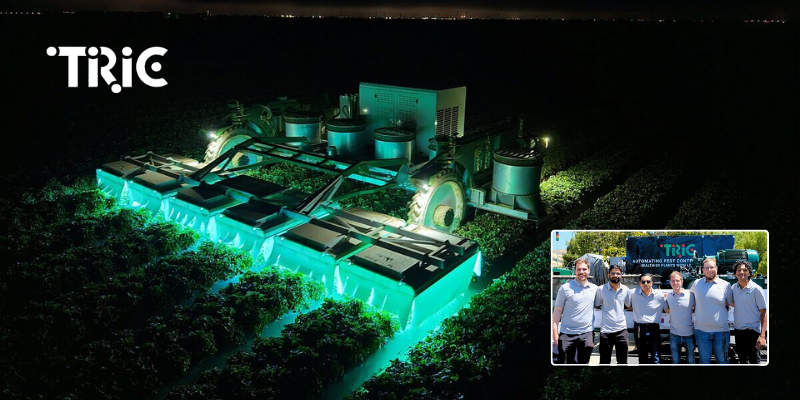
Strawberries are one of American agriculture’s great contradictions. They are beloved, high-value, and grown at enormous scale, yet they consume more chemicals per acre than almost any other fruit or vegetable, enough to land them near the top of the Environmental Working Group’s annual “Dirty Dozen” ranking of the most pesticide-contaminated produce. They are also brutally labor-intensive, grown low to the ground in dense open fields that resist easy automation.
A San Luis Obispo startup called TRIC Robotics thinks the fix for both problems is a tractor-sized robot that trades chemicals for light.
The pitch: pest control after dark
TRIC’s approach centers on ultraviolet light as a chemical-free treatment for the mites, mildews, and molds that plague strawberry growers. Its robots roll down the rows and bathe the plants in UV-C, a short-wavelength ultraviolet band that the earth’s atmosphere mostly filters out before it reaches the ground. That scarcity is the whole point. UV-C damages the DNA of fungal pathogens and pest eggs so they can’t replicate.
Timing matters as much as the light itself. During the day, plants and pests are naturally exposed to milder UV, but daytime UVA light also triggers a biological repair process that undoes the damage. By applying concentrated UV-C at night, TRIC’s robots inflict the damage faster and skip the window in which pests would otherwise recover, which is why the service runs after dark, covering every acre twice a week. It’s a clever exploitation of plant and pest biology, and it grew out of USDA research into ultraviolet light as a chemical replacement, as TRIC founder Adam Stager explained in a TechCrunch interview.
TRIC has since bolted on a second capability: a fully electric six-row bug vacuum that physically sucks up pests like lygus bugs, the tarnished plant bugs that damage developing berries, without harming the crop. The vacuum was a direct response to farmer feedback, per TechCrunch’s reporting: growers already using the robots for disease control mentioned they had a pest problem too. That pattern of expanding what a single robot can do, once it’s already trusted in the field, is central to the company’s strategy.
Two robots, one job
TRIC runs two tractor-scale platforms. The Eden fleet is dedicated to UV light application, three-wheeled machines with a span of more than 40 feet, built to match the form factor of conventional spray rigs so they can navigate tight turns and obstacles. The newer Luna platform, introduced in 2023, is the multi-payload flagship: designed in the mold of the strawberry industry’s familiar Harvest Pro, it covers six rows with a range of 50–100 acres and can carry a UV boom, bug vacuums, and cameras for real-time plant analytics all on the same chassis.
A notable engineering detail: the robots aren’t battery-powered. TRIC’s own FAQ explains that its first robots ran on batteries, but the company learned there was often nowhere in the field to charge them, so it mounted a diesel generator directly on each robot instead, a pragmatic concession to the realities of farm infrastructure.
Robots as a service, not a sale
Perhaps the most important decision TRIC made wasn’t technological at all. Rather than selling expensive robots to farmers, the company runs them as a service, deploying and managing its own fleet to treat fields on a recurring schedule. TRIC sets up the robots, runs them at night, and folds the results into a grower’s existing integrated pest management program. Farmers pay roughly what they would for conventional pest and disease control, no hardware to buy, which eliminates the upfront capital barrier that has sunk plenty of ag-robotics companies.
The service model also generates something valuable beyond clean berries: data. Because the robots return to the same fields on a bi-weekly cycle equipped with computer vision, they build a running record of pest pressure and field conditions over time. TRIC pitches this as a decision-making tool for growers, and as a foundation for layering on future services.
The benefits TRIC emphasizes go beyond a lower chemical bill. Because pests can’t build resistance to UV the way they do to chemistries, the company frames light as a more durable long-term control. It also positions UV as the only organic solution for botrytis, a common cause of lost berries, and points to the elimination of re-entry waiting periods that keep workers out of freshly sprayed fields, plus a path toward organic pricing. According to TechCrunch, the approach has cut pesticide use by up to 70% on the fields where it operates.
From SWAT robots to strawberries
TRIC’s path here was anything but linear. As TechCrunch recounts, Stager launched the company in 2017 after finishing a PhD in robotics, and its original focus was 3D-printed robots for SWAT teams. He later pivoted, driven by a desire to do something with broader impact, and reached out to the USDA to find research worth commercializing. That search led him to UV light and to strawberries, the crop where the chemical problem is most acute.
TRIC’s own timeline traces the hardware from there: a 2019 proof of concept, built from aluminum scaffolding, that got the company onto its first strawberry field at Fifer Orchards in Delaware; a steel-upgraded 2020 prototype that the team drove across the country to deploy in Watsonville and Santa Maria, California; the five- and seven-bed Eden robots of 2021 and 2022; and the Luna platform in 2023.
California was a deliberate destination. Roughly 90% of the country’s fresh strawberries are grown in the state, and its major growing regions all sit within driving distance of TRIC’s Central Coast base, a geographic density that makes a fleet-service model far more practical than it would be for a more scattered crop.
Fresh funding and a crowded-but-open field
In July 2025, TRIC closed an oversubscribed $5.5 million seed round led by Version One Ventures, with participation from Garage Capital, Valor Equity Partners, and others, including angel backing from the founders of Clearpath Robotics. The fleet had doubled over the prior year to nine robots, with three more in production, serving four large strawberry producers.
The plan for the money is straightforward: build more robots, push into untapped California growing regions like Oxnard and Watsonville, and develop the next generation of automation and analytics. Longer term, TRIC wants to move beyond strawberries into other specialty crops, since UV treatment works on a wide range of plants.
TRIC isn’t alone in the UV-for-agriculture space. Dutch firm CleanLight is well established in European greenhouses, and Norway’s Saga Robotics has gained traction with a UV system in UK strawberries and US vineyards. TRIC’s differentiator is its bet on large, tractor-scale machines built for open fields rather than the small robots suited to tabletop greenhouse growing, a size that raises the barrier to entry and leaves room to bolt on more capabilities over time.
The bigger picture
TRIC’s story sits at the intersection of three pressures reshaping agriculture: tightening environmental regulation, rising consumer demand for chemical-free produce, and a persistent farm-labor shortage. Chemical pest control is also hitting its own limits, with growers facing resistance and a thin pipeline of new approved chemistries.
Whether UV robots become a mainstream tool or remain a niche solution will depend on how the economics scale and how consistently the technology performs across seasons and crops. But TRIC has made a credible early case that the future of pest control might be less about what you spray and more about what you shine.