
It’s Here: The Super El Niño Has Officially Arrived and Central Valley Growers Are Bracing for Impact
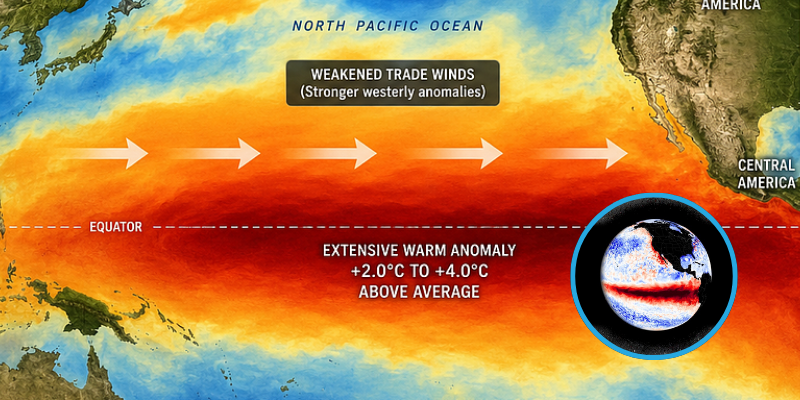
It has arrived. After months of mounting scientific signals, NOAA confirmed in June that El Niño is already underway in the tropical Pacific and it is shaping up to be something far more consequential than the garden-variety climate wobble that farmers and water managers have learned to navigate. Meteorologists are now calling it a “Super El Niño,” and for California’s Central Valley, the produce basket of the nation, the stakes could hardly be higher.
What Makes This One “Super”
El Niño occurs every two to seven years when trade winds weaken, allowing warm water to surge eastward across the equatorial Pacific. The result is a cascade of disrupted weather patterns worldwide: droughts in some regions, floods in others, scrambled agricultural seasons from Southeast Asia to South America.
But this year’s event is in a different class. The latest NOAA forecast shows nearly 90% odds of the event reaching at least “strong” intensity by autumn, and over 60% odds of a “very strong”, or Super, event. According to California climate scientist Daniel Swain of Weather West, international modeling centers are in remarkable agreement: 11 out of 13 major modeling ensembles are projecting a top-tier Super El Niño, and 8 of 13 predict an event that would exceed the historical maximum from the legendary 1982–83 season.
What makes 2026 particularly unprecedented is the baseline on which this El Niño is building. The warming from El Niño, typically 0.2–0.4°C, is stacking on top of roughly 1.4–1.5°C of already-accumulated human-caused global warming. The two forces are additive, meaning this event arrives in a world that is already running hotter than at any point in recorded history. Scientists predict it could make 2027 the warmest year on record.
A Summer of Heat, Humidity, and Uncertainty for the Valley
For Central Valley growers, who collectively produce a quarter of the nation’s food supply, the immediate concern is the coming summer. The El Niño effect does not arrive as a single storm but as a slow-building transformation of the atmosphere, and 2026’s version is already making itself felt.
A marine heat wave has been baking the Pacific Coast since late winter, and while it has pushed warmer, more humid air inland, the bigger near-term risk for the Valley is sustained heat. AccuWeather’s summer 2026 forecast projects the worst heat compared to historical averages will focus on the West, with California among the states most affected. That means hotter nights, greater evapotranspiration demand on crops, and critically higher water stress at a time when growers are already watching the water picture with deep anxiety.
The humidity angle is also new and concerning. California’s agricultural regions are accustomed to a dry heat that, while brutal, is at least familiar. This summer, elevated Pacific sea surface temperatures are pumping more moisture into the atmosphere, creating conditions that are more humid than usual. If a major heat wave hits during these conditions, the human and crop health impacts could be considerably worse than a standard summer spike.
The Water Question: Promise and Peril
Water is the lifeblood of Central Valley agriculture, and no aspect of the Super El Niño is more consequential, or more complicated, for growers than what it means for California’s water supply.
The short-term picture is one of tension. Despite a winter that saw multiple years of above-average precipitation help rebuild California’s reservoirs, Sierra Nevada snowpack crashed early this year, dropping to roughly 18% of the April 1 average, a critical “frozen reservoir” that typically feeds irrigation canals through the dry summer months. The premature melt has left growers in a precarious position heading into peak irrigation season. California’s congressional delegation representing the San Joaquin Valley, Reps. Jim Costa and Adam Gray, publicly blasted the Bureau of Reclamation in February over 2026 Central Valley Project water allocations they called unjustifiably low given recent wet years.
The longer-term picture, however, carries genuine hope, with significant caveats. Strong El Niño events historically increase the odds of a wet winter in California, and research has shown that this relationship becomes clearest and most reliable for the strongest events. The two previous Super El Niños on record, 1982–83 and 1997–98, were both very wet years for California. Swain and other climate scientists believe that when El Niño is strong enough, the signal rises above the noise: it strengthens both the polar and subtropical jet streams near California simultaneously, driving wetter and stormier conditions from November through April.
The key word, though, is “odds.” A wet winter 2026–27 is more likely than not, not a certainty. The cautionary tale is 2015–16, when a very strong El Niño did not produce the wet winter widely anticipated. Growers who plan for a silver bullet in the form of winter rains could find themselves badly exposed.
What History and Science Tell Growers
For crops that benefit from a wet winter and a milder summer, El Niño can actually be a tailwind. Research cited by Fortune magazine confirms that higher rainfall in California during strong El Niño years tends to improve yields for avocados and almonds, two crops that are Central Valley staples. Grapes, stone fruits, and pistachios may also benefit if rainfall timing aligns with dormant season needs and summer temperatures remain manageable.
But the risk ledger has entries on the other side, too. During strong El Niño winters, California has experienced catastrophic flooding. When atmospheric rivers cluster, and research shows they are more than twice as likely to cluster during El Niño conditions, the results can be devastating. Growers near the Tulare Lake basin still remember the 2022–23 winter, when atmospheric river storms swamped 150,000 acres and wiped out pistachio and other specialty crops worth tens of millions of dollars. The same mechanism that could refill reservoirs and recharge groundwater could also drown fields and destroy orchards.
Weather West’s Swain flags another flood dimension: coastal sea levels during major El Niño winters can run 6–10 inches higher than normal from a combination of thermal expansion and coastally-trapped ocean waves and this rise stacks on top of roughly the same amount of permanent sea level rise from a century of global warming. During major winter storms, total ocean and estuary levels could exceed historical records by two to three feet or more, threatening not just coastal areas but low-lying Valley farmland near river systems.
The Processing Tomato Season: A Case Study in Uncertainty
The Central Valley’s processing tomato season offers a microcosm of the broader challenge facing growers. According to Tomato News, the 2026 season is already being shaped by two intersecting forces: the early collapse of Sierra snowpack, threatening late-summer irrigation supplies, and the emerging El Niño pattern that could reshape global tomato markets as well as local production conditions.
Processing tomato growers in the Valley depend heavily on predictable water deliveries and summer heat units to drive yield and lycopene content. A summer that runs wetter and more unsettled than usual, something the ECMWF model ensemble is projecting for the August–October window across much of California, could disrupt harvest operations and soil conditions even as it complicates supply chains for a crop that is grown on contract.
The Big Picture: A Food System Under Pressure
The Super El Niño of 2026 is not just a California story. Globally, the disruptions from a very strong event will reverberate through commodity markets for crops that underpin much of the world’s food supply. Staples like rice, wheat, coffee, and sugar are grown in regions, Southeast Asia, Australia, East Africa, the Caribbean, that historically see drought during strong El Niño episodes. Supply tightening in those markets tends to raise prices, shift trade flows, and put pressure on the entire food system.
For Central Valley growers who compete in global markets, this cuts both ways. Disrupted international supply can create export opportunities. But it can also scramble input markets, raise energy and transportation costs, and complicate the planning horizons that specialty crop producers depend on.
Looking Ahead: Preparation Over Prediction
What should growers and water managers in the Central Valley be doing right now? Experts say the most valuable feature of this year’s forecast, unusual even by El Niño standards, is its advance warning. We know, with high confidence, that the next six to twelve months carry elevated risk of heat extremes this summer and elevated odds of a wet, stormy, and potentially flood-prone winter. That is an unusually strong predictive signal.
For growers, that means stress-testing irrigation plans against both a hot, water-short summer and a wet winter that could bring flood risk alongside relief. It means reviewing crop insurance coverage for extreme weather scenarios. It means engaging with water districts now about allocation outlooks and groundwater access. And it means watching, closely, as the science becomes clearer in the months ahead.
The Super El Niño is not a disaster waiting to happen. Nor is it a guaranteed windfall. It is, in the truest sense, a fork in the road, a moment when the choices made in the coming weeks and months will determine whether California’s growers emerge from 2026–27 with replenished reservoirs and a stronger footing, or whether they face yet another season of compounding losses.
The Pacific has spoken. Now the Valley must listen.