
California Almonds Are Quietly Having a Comeback and Here’s What the Latest Numbers Show
Exports are surging, the domestic market just snapped a losing streak, and the 2026 crop is already raising questions.
The Almond Board of California dropped its March 2026 Position Report on April 9th, and for an industry that’s had a lot to grind through this season, there’s finally some real momentum to talk about. Exports are outpacing last year, the domestic market just broke a months-long slump, and growers and handlers are already watching the horizon for what the 2026 crop might bring. Here’s our breakdown of what this report is telling us and what it means for California agriculture.
The Export Market Is Carrying the Load
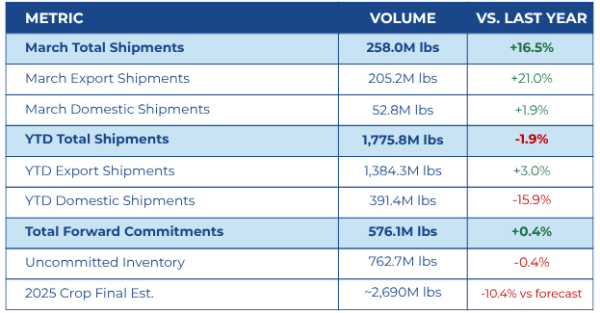
If there’s one clear story in this report, it’s that global demand for California almonds is strong and it’s been doing a lot of the heavy lifting all season. March exports came in at over 205 million pounds, up 21% from the same month last year. That’s a big number. Year-to-date, exports are now running 3% ahead of last year at 1.38 billion pounds, which puts the season back in positive territory on the export side.
Europe has been one of the most consistent buyers all year, and markets across Southeast Asia, particularly Vietnam, have been on a tear. Even the Middle East, which has faced real logistical headaches due to ongoing regional conflict, is still absorbing volume. The difference is where the product is landing. Buyers in that region are finding alternative routes through Turkey and Pakistan rather than slowing their purchases. That’s a sign of genuine demand, not just pipeline movement.
The one asterisk worth noting is China. Tariffs have significantly cut into shipments there, year-to-date volumes are down 45%, and that’s a hole the industry has had to fill elsewhere. So far, it has. But China’s absence from the table remains a real factor for the back half of the season and into next year.
The big takeaway here is that California almonds are finding buyers. The global appetite is there. The challenge isn’t demand, it’s navigating the trade and logistics disruptions that keep reshuffling where that demand shows up.
The Domestic Market Finally Caught a Break
Here at home, the news is more cautious but still worth celebrating. March domestic shipments came in at 52.8 million pounds, which is up 1.9% year-over-year. That might not sound like much, but context matters: this is the first month-over-month gain the domestic market has posted since November 2024. The losing streak is over.
That said, the domestic side of the business has a lot of ground to make up. Year-to-date domestic shipments are still down nearly 16% from last year. Retail and food manufacturing buyers have been cautious working through existing inventory rather than booking new supply aggressively. What’s encouraging is that new forward bookings picked up significantly in March, and total domestic commitments are now sitting at 212 million pounds. With four months left in the crop year and a normalized shipping pace, the math suggests domestic can get back to last year’s levels by the time the season closes out.
One month doesn’t make a trend, however after months of decline, the domestic market showing any positive movement is a signal worth watching closely
By the Numbers
A snapshot of where the 2025–2026 season stands through March 31, 2026:
What’s Coming: The 2026 Crop Is Already on Everyone’s Mind
With the 2025 crop essentially wrapped up around 2.69 billion pounds, well short of the 3 billion pound forecast, attention is already pivoting to what 2026 looks like. And the early signals are giving growers reason to be cautious.
Bloom conditions this spring weren’t ideal. Above-average temperatures and some erratic weather introduced uncertainty around how well the crop set. Water is a growing concern too with California’s snowpack coming in below average this winter, and SGMA groundwater regulations are continuing to tighten what’s available for irrigation across the valley. Add rising fuel and fertilizer costs tied to Middle East tensions, and growers are facing a real squeeze on both the yield and cost side.
There’s also a wildcard from the southern hemisphere: Australia’s almond crop has reportedly suffered quality issues due to late-season rainfall. That could push buyers in Asia who typically source from both origins to lean more heavily on California, a potential silver lining for growers here.
The industry will get its first hard data points soon. LandIQ releases its initial 2026 standing acreage estimate on April 23, and the USDA NASS subjective estimate follows on May 12. Those numbers will set the tone for where the market heads through summer.
If the 2026 crop comes in short, and the early signals suggest it might, growers and buyers alike could be looking at tighter supply and firmer pricing heading into the next crop year. Keep an eye on those May estimates.
The Bottom Line
The March report is, overall, an encouraging read for California’s almond industry. Exports are strong and diversified. The domestic market is stabilizing. Inventory is balanced without any sign of a glut. And while there are real headwinds, tariffs, geopolitics, water, and a below-forecast crop, the industry has shown it can adapt and find demand wherever it exists globally.
The next few months will be telling. Watch the crop estimates, watch domestic bookings, and watch whether China finds a way back to the table. For now, California almonds are in better shape than the season suggested they’d be and that’s a story worth paying attention to.
Read the Full Reports
For the complete data behind this article, check out the original sources: