
The Next Governor Will Make or Break California Farming & Here’s Where Each Candidate Stands
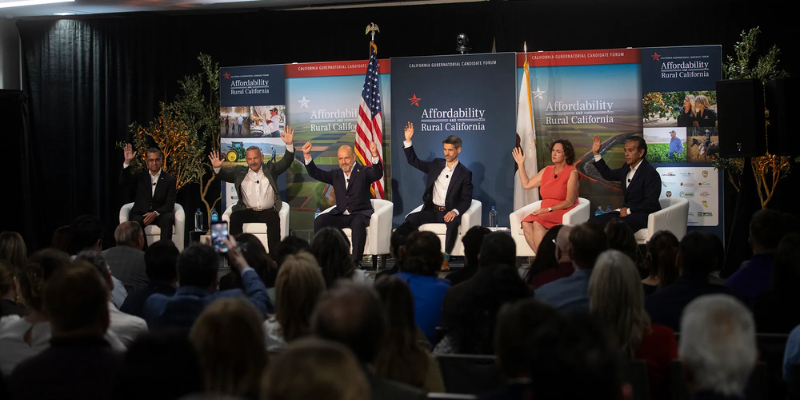
For the first time in recent memory, California’s gubernatorial candidates were put in a room full of farmers and forced to answer for it and what happened next was equal parts encouraging, frustrating, and revealing.
Six of the top gubernatorial candidates converged at California State University, Fresno on April 1 for an agriculture-focused forum that underscored a striking dynamic in the race: broad agreement that state policies are driving up costs for farmers, even as candidates diverge sharply on how to fix them.
The Maddy Institute, along with Western Growers, the Agricultural Council of California, and the California Farm Bureau hosted the forum. Former California state legislator Kristin Olsen-Cate and Fresno County District 4 Supervisor Buddy Mendes moderated. The candidates, Xavier Becerra, Chad Bianco, Steve Hilton, Matt Mahan, Katie Porter, and Antonio Villaraigosa, each had two minutes to deliver opening and closing statements.
Two candidates who were invited, billionaire Tom Steyer and Congressman Eric Swalwell, skipped entirely. Moderator Buddy Mendes didn’t hold back, calling them both “chicken hearts” for missing the only debate focused entirely on rural California and farm sustainability.
As Blake Zante of the Maddy Institute put it in his opening: “This region produces a quarter of the nation’s fruits and nuts, grows more than 350 commodities, helps feed the world and yet at the same time, many Valley communities face high poverty and higher than average unemployment.”
The One Thing Every Candidate Agreed On
Six candidates. Two parties. One consensus: California is drowning in regulation and it is strangling agriculture.
Chad Bianco was direct: “The cost of living is predominantly due to regulations and taxes, end of story. So how do you fix it? You remove the regulation and you reduce or eliminate the taxes. It’s that simple.”
Several Democrats joined Republicans in criticizing Sacramento’s regulatory framework, which was a notable shift in tone for a state long defined by aggressive environmental and labor policies.
Each candidate agreed that farming has too much regulation in the state and that California needs to help farmers by giving them more incentives to stay.
Dave Puglia, president and CEO of Western Growers, summed it up after the forum: “It’s quite encouraging that all six of these candidates thematically agree that California is going in the wrong direction as it relates to agriculture. We’re no longer pretending that California is the most powerful state in the country, has the fourth largest economy, and that all is good. All is not good.”
Water: Where Things Got Real
Water brought the sharpest divides of the entire forum. Every candidate was pressed on storage, the Delta, and the Sustainable Groundwater Management Act and none of the answers were identical.
Most candidates endorsed an “all-of-the-above” approach to water storage and conveyance, though their proposals varied widely. Bianco called for building “massive dams” and additional reservoirs, while Hilton advocated for dredging the Sacramento-San Joaquin Delta and raising Shasta Dam. Villaraigosa agreed on a comprehensive strategy, while Porter cautioned that “there is no magic wand to create more water.”
On SGMA, the groundwater law that has fallowed hundreds of thousands of Valley acres, Bianco left no room for interpretation: “You elect me as your governor so we can do away with it.” Others criticized the law as overly burdensome without committing to repeal it outright.
Energy costs also emerged as a major concern. Hilton stated: “We will use California natural gas to generate electricity… to cut your electric bills in half.”
CEQA, Gas Prices, and the Cost of Doing Business
The conversation kept circling back to CEQA, California’s environmental review law that farmers and infrastructure developers have long argued is used to kill or delay projects for years.
San Jose Mayor Matt Mahan called for a sweeping overhaul: “We need to completely overhaul CEQA, particularly for infrastructure like water conveyance, for the housing that we need. We need exemptions and strict limits on who can sue.”
Villaraigosa warned of the real-world cost of inaction on energy regulation: “If we continue to over-regulate refineries, one more goes down, gas prices are going to $8.75 a gallon. I’ve got a plan.”
And Becerra staked out the most aggressive executive territory, pledging: “I’m going to freeze your property insurance costs. I’m going to freeze your utility rates so we can look behind the curtain and figure out why they’re charging us so much and making so much profit at our expense.”
The Partisan Fireworks
While much of the forum featured surprising cross-party agreement, the gloves came off between Hilton and the Democratic field. Hilton opened by demanding accountability: “I think every single Democrat on this stage today should start with an apology, an apology for what their party has done to this area and this industry, stealing your water, piling on the regulations, a 1,000% increase in the last decade or so cutting the pay of agricultural workers. On and on, the assault on this industry has to stop.”
Villaraigosa pushed back, telling Hilton that making issues purely partisan means “you’re never going to get elected in this state.” The back-and-forth that followed captured exactly the tension gripping California agriculture, a sector that desperately needs results but is watching Sacramento politics slow everything down.
Why This Matters Before June 2
The candidates largely agreed on one point: the fate of rural California and the agricultural industry that underpins it will be a defining issue for the state’s next governor.
The June 2 primary is weeks away. Under California’s top-two primary system, the two candidates with the most votes advance regardless of party. That means two Republicans, two Democrats, or one of each could face off in November.
For Central Valley growers, the message is simple: agriculture showed up and made its voice heard at Fresno State. Now it needs to show up again at the ballot box.
Watch the Full Forum
Watch the complete “Affordability and Rural California” gubernatorial forum hosted at Fresno State. Click the link below to watch the full segment:
Affordability and Rural California — 2026 CA Gubernatorial Forum at Fresno State (Full Broadcast)