
Rooted in Research, Driven by Purpose: Whitney Cheatwood’s Path in Viticulture
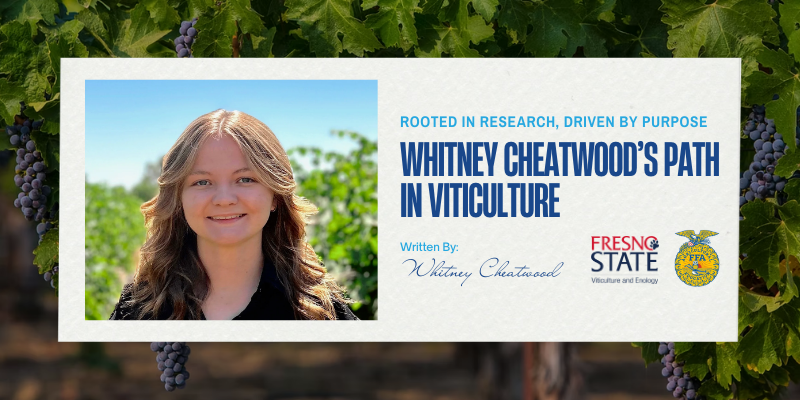
Raised in Fowler, California, Whitney Cheatwood grew up surrounded by agriculture. While extended family members were involved in raisins, row crops, and other sectors of the industry, her early years were not defined by direct participation. What she knew, however, was that she wanted a life outdoors, one grounded in tangible work and meaningful contribution.
That clarity began to take shape when she joined the FFA program at Kerman High School. Over four years, FFA transformed from an extracurricular activity into a defining influence. Through competitive events, chapter leadership roles, and hands-on agricultural experiences, Whitney discovered not only a passion for agriculture but a clear sense of direction.
That trajectory ultimately led her to pursue higher education in agriculture, first through Agricultural Education and soon thereafter into the Viticulture and Enology program at California State University, Fresno. Since then, she has immersed herself in the academic, research, and leadership opportunities the program offers, earning her bachelor’s degree in Viticulture and continuing directly into a master’s program.
Discovering Viticulture: Where Science Meets Art
Whitney’s introduction to viticulture began with her FFA chapter’s Vine Pruning team. Working directly in the vineyard, observing the progression from pruning through harvest, sparked an immediate and lasting interest.
While she appreciated every dimension of agriculture, plants and crop development held a particular appeal. Exposure to the enology side of the industry further deepened her interest. Learning how vineyard management decisions directly influence the character, chemistry, and artistry of wine revealed the complex integration of science and creativity that defines the field.
That intersection, where plant physiology, chemistry, and craftsmanship converge, solidified viticulture as more than an academic focus. It became a professional calling.
Advancing Knowledge Through Research and Innovation
Throughout her undergraduate studies, Whitney became heavily involved in research at the Viticulture and Enology Research Center. The dual exposure to fieldwork and laboratory analysis strengthened her commitment to the scientific side of the industry.
During harvest seasons, she conducted wet chemistry analyses including Brix (sugar concentration), pH, and titratable acidity for industry contracts. Her work extended into table grape research, evaluating berry texture, color development, and other quality parameters critical to commercial production.
In the summer of 2025, Whitney expanded her technical expertise by working directly with the FOSS Winescan system, processing samples for both the Fresno State Winery and research initiatives. Currently, her graduate work includes running HPLC analyses and conducting multi-year data comparisons, research that integrates laboratory precision with field-based application.
One of her most formative experiences has been her involvement in a multi-year table grape research project under the mentorship of Dr. Sonet Van Zyl. Travel to the McFarland region during harvest seasons provided hands-on exposure to experimental vineyard blocks, data collection, and the observable impact of research on vine phenology and growth. Witnessing how research directly influences production practices reinforced her long-term interest in contributing to industry advancement.
Leadership and Industry Engagement
Beyond the laboratory and vineyard, Whitney has demonstrated sustained leadership within the Viticulture Club at Fresno State, serving two years as president in addition to other officer roles.
In this capacity, she organized fundraisers, coordinated industry field trips, facilitated meetings, supported FFA Field Day events, and strengthened relationships with alumni and industry professionals. Collaboration with peer institutions such as UC Davis and Cal Poly further broadened her network and perspective.
Her leadership also extended into participation with committees such as Aspire to Grow and the Enology Society of Fresno — experiences that developed her organizational, communication, and strategic planning skills.
Bridging Academia and Industry
Whitney’s internship with Sun-Maid Growers of California provided valuable exposure to real-world agricultural operations. Working directly with growers and industry professionals allowed her to translate academic knowledge into applied practice.
The experience reinforced her interest in grower relations, a potential career pathway that would allow her to remain closely connected to vineyard operations while serving as a bridge between research, production, and industry stakeholders.
Lessons in Growth and Resilience
Whitney identifies balance as one of the most significant challenges of her academic journey. Managing coursework, research responsibilities, leadership commitments, and personal life required intentional time management and the willingness to seek support when necessary.
Mentorship has played a critical role in that growth. Dr. Sonet Van Zyl has been instrumental in expanding Whitney’s research experience and professional exposure. Faculty and departmental staff have provided consistent encouragement across academic and extracurricular pursuits.
Equally influential has been the support of her parents. Although not from agricultural backgrounds, their encouragement has provided stability and motivation throughout her educational path.
Among the most valuable lessons she has learned are deceptively simple: make connections, ask questions, and accept opportunities. Entering the department without established industry ties, Whitney built her professional network through engagement, curiosity, and initiative, a foundation that continues to shape her career.
The Role of Young Professionals in Agriculture’s Future
Whitney believes young professionals bring critical perspective to the future of agriculture and viticulture. Younger generations are uniquely attuned to consumer trends, evolving marketing platforms, and changing preferences, particularly within the wine and beverage industries.
From product innovation to experiential tastings and digital communication strategies, youth engagement can help position the industry to remain competitive and relevant. More broadly, young agricultural professionals serve as ambassadors, translating complex agricultural systems into accessible, accurate information for a broader audience.
Looking Ahead
As Whitney progresses through her master’s program, she remains open to multiple professional pathways. Whether continuing in research or transitioning directly into industry, particularly in grower relations, her focus remains consistent: contributing meaningfully to viticulture through knowledge, collaboration, and applied science.
Her journey reflects a broader truth about agriculture. It is not simply an industry, it is a community, a discipline, and a lifelong pursuit of growth.
For students considering a future in viticulture or agricultural research, her advice is direct: pursue internships, cultivate relationships, remain curious, and engage fully in the opportunities presented. Agriculture not only feeds the world, it cultivates purpose in those who dedicate themselves to it.