
California’s Snowpack Is Still 34% Below Average — And March Is the Last Real Shot to Close the Gap
With bloom season underway across the Central Valley and irrigation demand ramping up, the state’s water picture heading into March is one that growers can’t afford to ignore. The Sierra Nevada snowpack — which supplies roughly 30 percent of California’s annual water needs — is sitting at just 66 percent of average as of February 27, according to the California Department of Water Resources (DWR). The window to recover is narrowing fast.
What the Latest Survey Shows
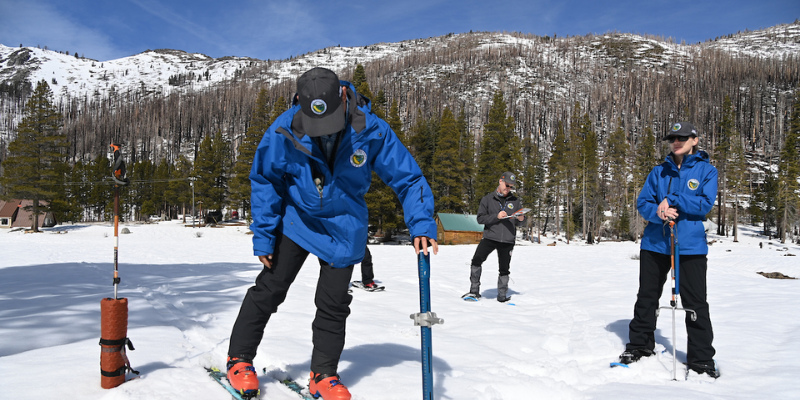
DWR conducted its third manual snow survey of the season at Phillips Station on February 27, recording 28 inches of snow depth and a snow water equivalent of 11 inches — 47 percent of the historical average at that location. Statewide, the figure was better at 66 percent of average, up from 59 percent at the end of January after a stretch of cold, productive storms broke a five-week dry period.
But that improvement came with an asterisk. DWR Director Karla Nemeth characterized the situation clearly: “Water supply in California increasingly depends on a small number of big storms. We face higher drought risk when they don’t arrive and greater urgency to modernize infrastructure to capture water when they do.”
The dramatic swings this winter — a wet December, a historically dry January, then a late-February recovery — are now a pattern California water managers are no longer treating as anomalies.
The SWP Allocation Picture
The State Water Project allocation currently sits at 30 percent of requested supplies, raised from the initial 10 percent announced December 1 following mid-December storms. That 30 percent figure serves 29 public water agencies covering 27 million Californians and 750,000 acres of farmland.
Whether that number moves higher before the season ends depends almost entirely on what March delivers. DWR updates allocations monthly, and the next survey is tentatively scheduled for April 1 — historically the date when the Sierra snowpack peaks before transitioning to runoff.
The saving grace so far this season has been reservoir storage. Statewide, major reservoirs are sitting at 122 percent of average, largely a carryover benefit from three consecutive years of above-average snowpack conditions. Lake Oroville, the SWP’s primary storage facility, came into this season in strong shape. That buffer has provided some operational flexibility, but it doesn’t change the underlying supply equation if March fails to produce.
What This Means for Growers Heading Into Spring
For operations in the San Joaquin Valley relying on SWP deliveries — particularly those running almonds, pistachios, citrus, or row crops — the current 30 percent allocation is the planning baseline until April.
- Irrigation scheduling needs to account for supply uncertainty. Even with strong reservoir carryover, surface water deliveries may not increase materially without significant March snowfall.
- Groundwater management becomes a factor earlier in the season. Operations that can shift flex demand to well water may do so, though groundwater basins facing SGMA compliance constraints have less room to maneuver.
- The April 1 survey is the number to watch. It is the single most consequential data point remaining for the 2026 water year. A strong early-April storm cycle could still push the allocation meaningfully higher. A dry March locks in a below-average supply picture.
The Bigger Pattern
This winter has reinforced what water managers have been saying for several years: California’s precipitation window is compressing and becoming less predictable. A dry January — historically the state’s wettest month — erased early gains almost entirely before February storms partially recovered them. The snowpack is still 34 points below average with one high-value month remaining.
DWR’s position is adaptation over assumption. The agency has leaned into real-time operational flexibility, including amendments to fish protection protocols that allowed the SWP to capture an additional 15,000 acre-feet during storm windows this season — enough water to supply 45,000 homes for a year. Governor Newsom also issued an executive order in January to facilitate groundwater recharge during high winter flows.
For growers, the operational takeaway is straightforward: plan for the 30 percent allocation, monitor the April 1 survey, and build contingency into irrigation planning now rather than in May.