
Famoso, AgWise & Wonderful Forecast 2.64 Billion Pounds, But Say the Next Few Years Are the Real Conversation
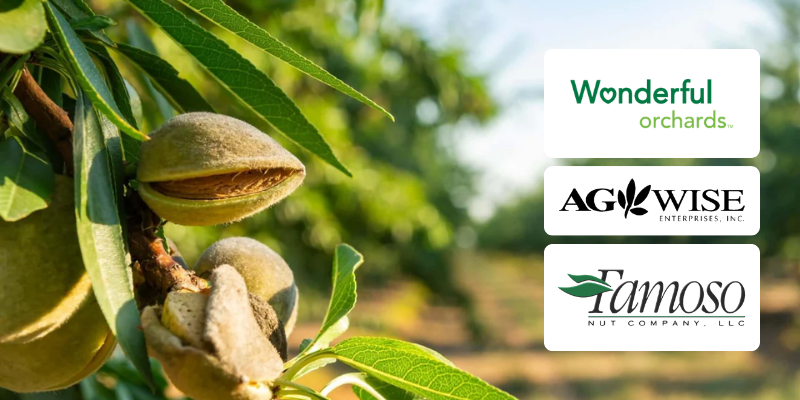
California’s almond industry has a new benchmark to chew on. A coalition of growers and ag professionals from Famoso Nut Company, AgWise Enterprises, and Wonderful Orchards completed their annual statewide crop tour this spring, releasing a 2026 forecast with a midpoint of 2.64 billion pounds with a range of 2.57 to 2.71 billion lbs. The report also notes that participants were more closely aligned this year than in 2025, with a notably narrower spread across individual estimates.
The estimate was produced by 14 crop tour participants, 10 of them active almond growers, who fanned out across the state’s three main growing regions: North, Central, and South. Each team evaluated orchards they have no personal stake in, attempting to replicate the kind of unbiased outside perspective that’s hard to get when you’re looking at your own trees. Individual estimates were then compiled with statistical weighting for historical accuracy by Abe Padilla, a data analytics professor at CSU Bakersfield.
“We feel that a better question to ask would be ‘How does your neighbor’s crop look?’ as this may give a more unbiased opinion.”
— 2026 Crop Estimate Report, Famoso / AgWise / Wonderful Orchards
A Historic Shift in Acreage
The headline number matters, but the bigger story may be structural. According to LandIQ’s 2026 initial acreage data, California almond bearing acreage fell by 15,226 acres, the first decline in 30 years. The last time bearing acreage contracted was 1996. Since then, the industry expanded almost without interruption, reaching its peak production of over 3.0 billion pounds in 2020.
What changed? New plantings have been slowing since 2022. Non-bearing acreage, young orchards not yet producing, peaked at 352,875 acres in 2021. Today that figure sits around 104,000 acres, a 70% drop. With 245,000 acres of orchards now over 20 years old and only 104,000 younger acres in the pipeline to replace them, the math is working against the industry. Simply put: more trees are being removed than planted, and that gap is widening.
The report puts it plainly, drawing an analogy to countries with aging populations: older orchards are not expected to be as productive as younger ones, and until new planting activity picks back up, the report suggests this will be the new reality the industry has to navigate.
Regional Breakdown
| NORTHERN REGION
Cold and wet bloom weather hurt many older orchards in Butte, Tehama, and Glenn counties, leading to poor nut sets and thin canopy growth. Younger orchards fared better on foliage but still showed inconsistent sets. Kernel sizes trended small, which puts pressure on yield. Solano County looked comparatively solid but faces a tough comparison after last year’s big Independence gains. |
CENTRAL REGION
The report describes this as the most stable of the three regions. Consistency was strongest in younger Independence blocks across Merced, San Joaquin, and Stanislaus counties. Older variety mixes were more erratic, with Nonpareil singled out as particularly inconsistent. The report also observes alternate-bearing tendencies in orchards 7th leaf and older. |
SOUTHERN REGION
The largest share of the crop and historically the key indicator. Some rebound was seen from a weak 2025, but with more inconsistency than expected. “Roadside attractions”, trees that look impressive from the road but underwhelm up close, were common. Kern County saw 7,500 acres of removals, making year-over-year gains difficult. |
The Independence Factor
One variety is reshaping what California almonds look like at the handler level: Independence. In 2016, it represented less than 1% of receipts. By 2025, it had climbed to 16.41%, a remarkable rise driven by the industry’s largest sustained planting cycle, which ran from roughly 2014 to 2021. As those orchards have matured, Independence has become the dominant new-era variety.
The flip side is that older standbys, Butte/Padre, Fritz, Peerless, are declining in share. With few new plantings underway, Independence is likely to keep growing its slice of total receipts simply by attrition.
Factors That Could Still Move the Number
WATCH LIST THROUGH HARVEST
- Weather: Growing season conditions remain unknown. The 2025 harvest benefited from mild temperatures and above-normal moisture; a repeat isn’t guaranteed.
- SGMA: The Sustainable Groundwater Management Act is tightening. Some water districts are already implementing restrictions, and growers — particularly in eastern Madera and Kern County — are making removal decisions based on future water availability.
- Nut size: Smaller-than-average kernel sizes were noted statewide. Critically, smaller sizes did not appear to be offset by heavier nut sets — a combination that puts downward pressure on yield.
- Australia: The report flagged a notably poor Australian harvest as a reminder that the global supply picture can shift from unexpected directions.
- Acreage removals: Kern County alone lost 7,500 acres per LandIQ data, compounding what is already a structurally tightening supply base.
What It Means for Our Market
For growers, handlers, and ag lenders in the Central Valley, the 2026 forecast offers a mixed picture. The near-term crop estimate is relatively tight, this isn’t a year of dramatic surprises in either direction. But the structural story is one the industry hasn’t faced in a generation: a shrinking, aging orchard base with limited young acreage coming in behind it.
For those watching almond prices, a supply base that trends smaller over the next several years, absent a resurgence in new plantings, generally supports pricing. But that same dynamic means growers managing older blocks face difficult decisions about when the economics of removal outweigh the value of another crop cycle.
Read The Full Report
To learn more and read the full 2026 Almond Crop Estimate for yourself, the complete report from Famoso Nut Company, AgWise Enterprises, and Wonderful Orchards is available directly at the link below:
https://theagcenter.com/wp-content/uploads/2026/05/2026-Famoso-Agwise-Wonderful-Estimate.pdf
The full report includes individual estimator data, historical accuracy comparisons, and detailed forecast visualizations prepared by Abe Padilla of CSU Bakersfield.