
California Was Drought-Free Three Months Ago. The Latest Drought Monitor Says It Won’t Stay That Way.
In January of this year, California made national headlines when the U.S. Drought Monitor declared the entire state drought-free for the first time in 25 years. Reservoirs were full, the wet season had delivered, and for a brief moment California’s chronic water anxiety seemed to ease. That window has closed faster than most people expected.
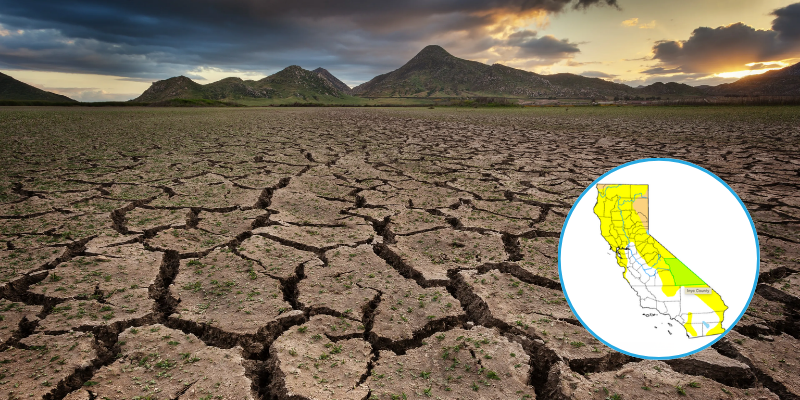
The Drought Monitor released its latest weekly map on Thursday, April 22, 2026, and the picture continues to get worse. Abnormally dry conditions are continuing to spread across counties throughout the state, and California’s snowpack has now plunged to just 10% to 20% of normal, an even steeper decline from the already alarming 18% reading recorded at the April 1 survey.
For California’s agricultural community and particularly for growers in the Central Valley who depend on reliable water supplies through the summer this is no longer a trend to watch. It is a condition to respond to.
What the Drought Monitor Is Actually Measuring
The U.S. Drought Monitor is a weekly joint product from the National Oceanic and Atmospheric Administration (NOAA), the U.S. Department of Agriculture (USDA), and the University of Nebraska-Lincoln’s National Drought Mitigation Center. Every Thursday morning it publishes a map classifying drought conditions across the country using a six-tier scale:
- None — No drought conditions
- D0 — Abnormally Dry (entering or exiting drought)
- D1 — Moderate Drought
- D2 — Severe Drought
- D3 — Extreme Drought
- D4 — Exceptional Drought
The map draws on dozens of data inputs per location: precipitation totals, streamflow, soil moisture, groundwater levels, snowpack, and on-the-ground observer reports. It is the most widely referenced drought tracking tool in the country and is used by USDA to trigger certain disaster declarations and loan eligibility thresholds.
How We Got Here: The January High and the March-April Collapse
To understand where California stands today, you have to understand the whiplash of the past three months.
January: California’s wet season has delivered in a big way. Multiple rounds of atmospheric rivers soaked the state between late November and early January. Reservoirs filled. Groundwater responded. And on January 8th, the Drought Monitor reported that not a single region in California was classified as drought or even abnormally dry, a status not seen since December 2000. It was a genuine milestone, 25 years in the making.
March: Then came the heat. California experienced an unprecedented heat event throughout March 2026, with record temperatures hitting the state weeks ahead of schedule. According to the California Department of Water Resources, the April 1 snow survey at Phillips Station found no measurable snow, the second lowest reading on record. The statewide snowpack peaked on February 24 and was effectively gone by the time spring arrived. DWR Director Karla Nemeth put it plainly: “It feels like we skipped spring this year and dropped straight into a summer heatwave. What should be gradual snowmelt happened suddenly weeks ago.”
April: With no snowmelt to slowly recharge the system and no meaningful rain arriving, conditions have continued to deteriorate every week. The April 22 Drought Monitor shows abnormally dry conditions spreading further across the state, with snowpack now down to just 10–20% of normal. Cal Fire Chief Joe Tyler has already flagged the downstream consequence: when snowpack is this low, moisture disappears from vegetation weeks earlier than normal and the drier the grass and brush, the easier it ignites and the faster fire moves. That is a concern that extends well beyond fire season and directly impacts the broader operating environment for Central Valley agriculture.
What This Means for California Agriculture
For growers, the drought monitor is more than a weather story, it is a water supply signal, and right now that signal is pointing in the wrong direction heading into the heart of the growing season.
Surface water deliveries are already constrained. Earlier this year, the Bureau of Reclamation set South-of-Delta Central Valley Project agricultural contractors at just 20% of their contracted allocation for 2026, a number that drew sharp criticism from Central Valley lawmakers. The slow, steady snowmelt runoff that normally supplements reservoir storage through May and June is simply not coming this year. Water managers are working entirely from what is already stored.
Reservoir storage provides a cushion for now. California’s reservoirs entered this water year in strong shape following multiple consecutive wet years. The California Water Watch tracker provides daily reservoir storage data and remains the best real-time tool for tracking how your region’s storage is holding up. But that buffer will be drawn down more aggressively than in a normal year because the snowmelt supplement is gone.
The dry season is arriving weeks early. Because the snowpack peaked in late February instead of early April, California effectively lost six weeks of gradual water input. The agricultural dry season, when irrigation demand peaks and supply is most constrained, is already here.
Groundwater pressure will increase. When surface water deliveries tighten, growers with groundwater access pump more. That pattern is well established in California drought history and creates additional pressure on already-stressed aquifers, particularly in the San Joaquin Valley where SGMA compliance requirements are already limiting how much water can legally be extracted in many basins.
The Bigger Picture: California’s Wet-Dry Whiplash
What happened between January and April 2026 is not unusual by California standards, it just happened faster and more dramatically than most years. California’s water managers have a term for it: “whiplash hydrology.” The state swings between extremes with increasing speed and intensity, making long-range planning harder than ever.
The NOAA California-Nevada Drought Early Warning System tracks these conditions in real time and provides seasonal outlooks for water managers and agricultural planners. Their current outlook does not favor significant precipitation relief through the spring, which means the drought conditions spreading on this week’s map are likely to persist or expand rather than improve in the near term.
For context on how rapidly things shifted: as recently as January 9, 2026, news outlets across the country were reporting on California’s historic drought-free status. Roughly 104 days later, abnormally dry conditions are spreading statewide and snowpack is nearly gone.
What Growers Should Do Right Now
This is an early warning trend that is now confirmed and worsening week over week. Growers who take action now will be better positioned than those who wait. Here is what to focus on:
- Know your water supply allocation. If you are a CVP or SWP contractor, confirm your current allocation percentage with your water district and understand what triggers any downward revisions. Updates are typically issued monthly through the end of the water year.
- Track reservoir levels in your region. The California Water Watch tool provides daily reservoir storage data for all major state-managed reservoirs. Know the status of the reservoir that feeds your district.
- Assess your groundwater position. If surface water tightens further, groundwater will be your backstop. Know your pumping rights, your SGMA basin’s current status, and your well capacity before you need it.
- Watch the weekly Drought Monitor. The map updates every Thursday morning at droughtmonitor.unl.edu. A single week moving from D0 to D1 in your county can have direct implications for USDA disaster designations and loan programs.
- Document conditions now. If you are already observing crop stress, irrigation shortfalls, or well performance changes this season, document them. That documentation will matter if disaster declarations or assistance programs are triggered later in the season.
The Bottom Line
California’s historic drought-free moment in January lasted less than a season. The same record March heat that disrupted pistachio bloom and erased the Sierra snowpack is now driving abnormally dry conditions that are spreading across the state week by week. With no meaningful precipitation in the forecast, snowpack at historic lows, and the dry season already underway, growers heading into summer need to treat the Drought Monitor as an active management tool, not background noise.
The U.S. Drought Monitor updates every Thursday. Make it part of your weekly routine.