
End of an Era: Del Monte’s Modesto Cannery Closes, Leaving Central Valley Fruit Growers in Crisis
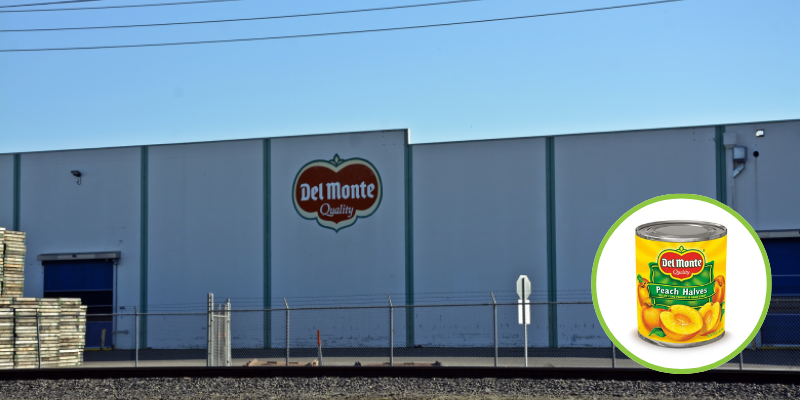
For more than a century, the Del Monte cannery on Yosemite Boulevard in Modesto stood as a fixture of California’s Central Valley. A place where generations of peach, pear, and apricot growers sent their harvests, and where thousands of workers built careers and raised families. This spring, that chapter closes for good.
Del Monte Foods filed for Chapter 11 bankruptcy in July 2025 and subsequently moved to sell off its assets through a court-supervised process. After months of uncertainty, no buyer came forward to purchase or operate the Modesto facility, being the last remaining Del Monte cannery in California. The company officially confirmed it would wind down operations at the site, with its final operating date set for April 7, 2026, according to its official notice to local government agencies.
The ripple effects are already being felt across hundreds of miles of Central Valley farmland.
A Community Gut-Punched
The closure will eliminate approximately 600 full-time jobs and 1,200 seasonal positions at the Modesto plant, according to Del Monte’s statement on the closure. But the economic damage extends far beyond the cannery floor. Trucking companies, farm labor contractors, packing sheds, equipment suppliers, and agricultural support businesses throughout Stanislaus, Sutter, and surrounding counties are all absorbing losses from the facility’s departure.
Jim Wolf, who operates Flow Transportation Services out of Hughson, told The Modesto Focus that his company would lose more than a million dollars in gross revenue. He had routinely dispatched 40 trucks from his Hughson fleet yard to haul peaches to the Modesto cannery each season. That business is now gone.
“We’ll lose a tremendous amount, grosswise,” Wolf said. “Over a million dollars, probably.”
Sutter County Supervisor Karm Bains described the moment a federal court approved the asset sale and with it, the fate of the Modesto plant as a defining blow. “For more than 140 years, Del Monte has been a cornerstone of American agriculture,” Bains said at a county board meeting. “This bankruptcy is going to have serious impacts on our local agricultural community.”
Farmers With No Buyer for Their Crop
The most devastating blow falls on the growers themselves, particularly cling peach farmers, whose fruit has virtually no fresh market. Cling peaches go almost exclusively to canneries, meaning without a processor, there is no sale. Period.
According to the California Farm Bureau’s Ag Alert, Del Monte had been contracting roughly 35% of California’s cling peach crop in recent years. More than 200 Sutter County peach-growing families alone have no confirmed processing home for their 2026 harvest, according to county officials.
Escalon farmer Richard Lial grows 105 acres of cling peaches and every acre of it under contract with Del Monte. His trees were already in full bloom when the closure was confirmed, their pink-white blossoms hinting at a summer harvest that may never be processed.
“One of my options is just to take everything out,” Lial told The Modesto Focus. “It will be a total loss.”
His story is not unique. Dozens of growers in Yuba and Sutter counties north of Sacramento gathered recently to grapple with the same question: with no buyer for their fruit, what do they do? One farmer, Carlos Barron, had only recently achieved his dream of owning his own land near Hughson, planting a peach orchard, installing irrigation, and securing a Del Monte contract. Young orchards don’t produce a return until roughly year four. This summer was supposed to be his first real harvest. Now, his buyer is gone.
“When you’ve got no home for your peaches, what do you do? Who do you talk to?” Barron said.
Ranjit Davit, a third-generation peach grower whose family has farmed near Live Oak for eight decades and who chairs the California Canning Peach Association’s board of directors, put it plainly: “Modesto talks about losing 1,800 employees, but look at us who have put up capital to plant peaches and spent years growing trees — all lost.”
The scale of potential losses is staggering. The Modesto Focus estimates growers stand to lose $550 million in peaches alone from the closure.
Pear Growers Also Caught in the Crossfire
It isn’t only peach farmers facing an uncertain future. California’s pear growers are similarly exposed. Chris Zanobini, executive director of the California Pear Advisory Board, said growers are deeply concerned about finding buyers for this year’s crop. While pears do have some fresh market presence, the majority of California pear production is sold to canneries and Del Monte had been purchasing more than 40% of California’s cannery pear tonnage as recently as last year. The sudden disappearance of that buyer has left pear growers in nearly as precarious a position as their peach-growing neighbors.
The Long Decline of Canned Fruit
The Del Monte closure didn’t happen overnight. It is the culmination of decades of structural shifts in how Americans eat and shop. The year-round availability of fresh fruit, powered by global supply chains and produce from the southern hemisphere, has steadily eroded demand for canned goods. Cheap imports and rising input costs have squeezed California processors from every direction.
According to data from the USDA’s National Agricultural Statistics Service (NASS), California’s bearing acreage of cling peaches has plummeted from more than 63,000 acres in 1969 to fewer than 14,000 acres today. A crop that once defined swaths of the San Joaquin Valley has been quietly shrinking for half a century. Where once eleven canneries processed fruit across the region, now only one major processor remains.
The bankruptcy itself was the final signal that the economics had become unsustainable. As one longtime industry observer noted to CapRadio: “I thought it was still a profitable business. And when I saw they were auctioning and no one was interested in operating, that was really the moment… the true gut punch.”
What Del Monte’s Assets Became
When the bankruptcy court approved the final asset sale, the Del Monte brand itself was split among several buyers. Fresh Del Monte Produce, a separate publicly traded company, acquired Del Monte Foods’ vegetable, tomato, and refrigerated fruit businesses, along with global ownership of the Del Monte brand. B&G Foods took over the company’s broth and stock lines. None of these buyers agreed to purchase or operate the Modesto cannery.
For the canned fruit side of the business, California-based cooperative Pacific Coast Producers (PCP) stepped in. In a press release dated March 19, 2026, PCP confirmed it had completed its purchase of Del Monte’s canned fruit and fruit cup assets, along with the rights to license and use the Del Monte and S&W brands for shelf-stable fruit products in the United States, Mexico, and Puerto Rico.
“The completion of this transaction is a significant event for our grower owners and for our company,” said Matt Strong, PCP’s President and CEO, in the release. “We will carry on our mission of producing and providing healthy and economically packaged fruit products to the U.S. consumer. We intend to continue to provide the high-quality products for the iconic Del Monte brand that consumers expect.”
Aaron Smith, PCP’s Vice President of Field Operations, acknowledged the company’s responsibility to the farming community directly: “We are committed to a viable agricultural community in our state. We have increased our purchases of west coast fruit in order to provide adequate supply to our customers and will maintain the quality consumers expect.”
PCP is a grower-owned agricultural cooperative of approximately 160 family farmers based in Northern California, operating production facilities in both California and Oregon with a workforce of over 4,000 employees. The company has been processing fruit since 1971 and currently runs canneries in Lodi, Oroville, and Oregon.
PCP Can’t Fill the Gap Entirely
As encouraging as PCP’s acquisition of the Del Monte brand is, industry insiders are clear-eyed that the cooperative cannot absorb all the volume Del Monte had been processing. Mona Shulman, PCP’s Vice President, told Ag Alert that PCP would procure fruit “to support a sustainable volume of Del Monte sales” but could not replace the company’s full production. She also cautioned that contracts offered this year may be shorter-term than the multi-decade arrangements growers have historically relied upon.
“To protect our company and not overcommit, it is likely a 20-year contract may not be the initial offering,” Shulman said.
For growers who spent years and in some cases decades, building orchards around a guaranteed long-term buyer, that uncertainty is deeply unsettling. The crop diversity that once characterized Central Valley agriculture is further narrowing, with many growers now weighing the difficult choice of whether to graft almond trees over their peach orchards or abandon fruit farming altogether.
“From 250 commercial crops grown in the county,” one longtime peach grower told CapRadio, “you can’t overplant any of them, and we’re getting more and more concentrated in just fewer and fewer commodities.”
What Comes Next
Sutter County officials say they are working with agricultural groups and industry partners to identify alternatives for affected growers, including short-term processing options and support for those facing decisions about removing orchards. But officials also warn that growers who pull out their trees will permanently alter the county’s agricultural landscape — and that once that acreage is converted, it rarely returns to canning fruit production.
The Del Monte closure is not happening in isolation. It comes as California farmers simultaneously navigate below-average water allocations tied to a weak Sierra snowpack, tariff-driven export uncertainty, and a Farm Bill still working its way through Congress. For many in the Central Valley, the loss of the Modesto cannery is one more weight added to an already heavy burden.
What is certain is that April 7, 2026 will mark the end of something irreplaceable — more than a century of Del Monte’s presence in California agriculture, and with it, a way of life for growers, workers, and communities that built their futures around a can of California fruit.